
CCPA / CPRA (California Consumer Privacy Act / California Privacy Rights Act)
A California state statute (2018, effective 2020) granting state residents specific data rights, since substantially expanded by an amendment, the California Privacy Rights Act (CPRA). It applies to any for-profit business meeting at least one threshold: over $25 million in annual gross revenue, buying/receiving/selling the personal information of 100,000 or more consumers or households, or earning more than half its revenue from selling personal information. Those thresholds catch most mid-size-and-larger consumer-facing sites regardless of where the business itself is based.
It applies to any for-profit business meeting at least one threshold: over $25 million in annual gross revenue, buying/receiving/selling the personal information of 100,000 or more consumers or households, or earning more than half its revenue from selling personal information.
Support the consumer rights the law grants
The interface has to give a California resident a real way to exercise each right:
- Know what personal data is held and why.
- Access a copy of it.
- Delete it.
- Opt out of its sale or “sharing” for cross-context advertising.
- Correct inaccurate data.
- Limit use of sensitive personal information such as precise geolocation or government ID numbers.
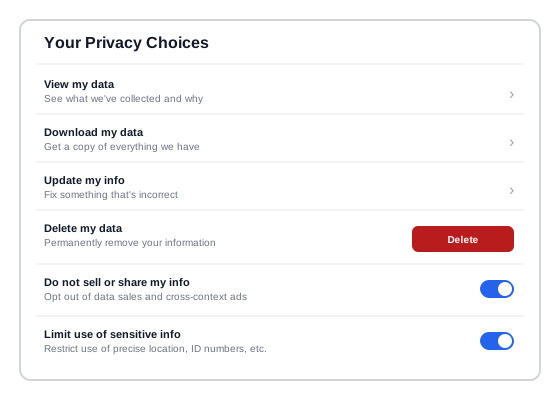 Each right shows up here as something a customer can actually do — a link, a button, a toggle — not just a promise buried in a privacy policy.
None of these can come at a cost to the customer — the law separately prohibits discriminating against anyone for exercising them.
Provide a homepage opt-out link
A business selling or sharing personal information must post a clearly labeled link on its homepage that lets a visitor exercise that choice without first creating an account or contacting support directly. The link was originally labeled “Do Not Sell My Personal Information.” Because the opt-out now covers “sharing” as well as sale, it’s commonly consolidated into “Your Privacy Choices” with a recognizable toggle icon. The CPRA also requires honoring a browser- or device-level opt-out preference signal (e.g., Global Privacy Control) as a valid opt-out in itself, so a compliant site can’t require a visitor to additionally click through its own link if that signal is already present.
A business selling or sharing personal information must post a clearly labeled link on its homepage that lets a visitor exercise that choice without first creating an account or contacting support directly.
Respond to requests within a fixed window
Verified consumer requests generally need a response within 45 days, extendable once by another 45 days with notice to the requester — a concrete deadline for whatever request-handling flow (see Account Management and Fair Information Practices‘s access principle) processes know/delete/correct requests.
Related Concepts
Patterns
Principles
Standards
Further reading
The California Attorney General’s “California Consumer Privacy Act (CCPA)” (California Department of Justice — copyright DOJ, no open license) is the enforcing regulator’s own summary of the law, adding operational requirements not covered above, such as a “notice at collection” given at the point where personal information is gathered.
Sources
California Consumer Privacy Act (Wikipedia) provided the applicability thresholds, the consumer-rights list (know/access/delete/opt-out/correct/limit), the homepage opt-out link and Global Privacy Control requirement, and the 45-day (extendable) response window.