
- Plan
- Explore
- Concept
- Evaluate
- Launch
Affinity Diagramming
Overview
What structure is actually hiding in a pile of raw research notes, before anyone imposes one on it?
A technique for turning raw research notes into a candidate Information Architecture by physically clustering related ideas together, rather than starting from an assumed structure. Often run on the same raw research data as Card Sorting — affinity diagramming clusters the researcher’s own field notes, while card sorting has customers do the categorizing themselves.
A technique for turning raw research notes into a candidate Information Architecture by physically clustering related ideas together, rather than starting from an assumed structure.
Cluster notes into a hierarchy
Write every individual point or concept gathered from interviews or observations on its own note, then physically cluster related notes together on a wall-sized surface. Draw connections between related clusters and use color to build up a hierarchy of groups and super-groups as the clustering progresses, rather than treating the first pass as final.
Draw connections between related clusters and use color to build up a hierarchy of groups and super-groups as the clustering progresses, rather than treating the first pass as final.
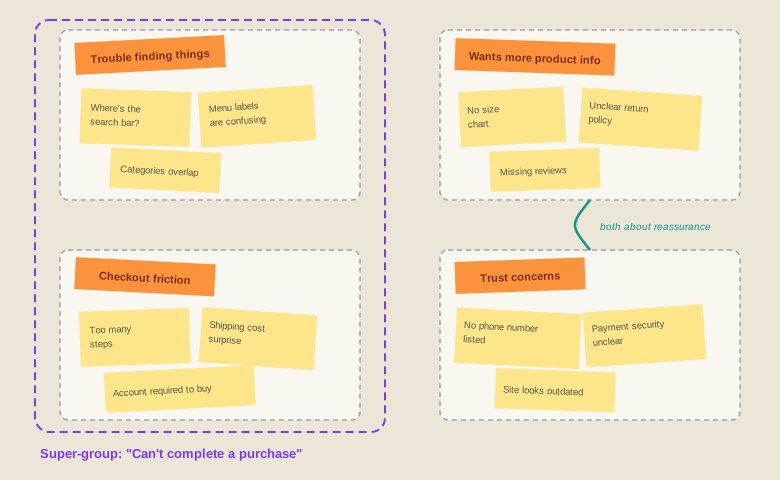 The same raw complaints, now readable as four named problems, two of which turn out to be one bigger problem in disguise.
Use the result to seed later design work
The result is a single visual map of customer problems and needs that the whole team can see at once, and it commonly becomes the first draft of a site’s information architecture — as well as a seed for later scenarios and storyboards. The same clustering process is what an interpretation session builds from a Contextual Inquiry visit, just applied to one visit’s notes rather than a broader set of interviews and observations.
Related Concepts
Principles
Processes
- Customer Research Methods
- Personas and Scenarios
- Card Sorting
- Rapid Prototyping
- Contextual Inquiry
- Storyboarding
Sources
The Design of Sites: Ch. 3 — Knowing Your Customers: Principles and Techniques (Ch. 3) is this page’s sole source — clustering raw interview and observation notes into a candidate information architecture, ahead of card sorting. The source’s own affinity-wall photograph isn’t shown directly; the illustration above recreates its cluster-and-connect structure with fictional customer complaints.