
About Us Pages
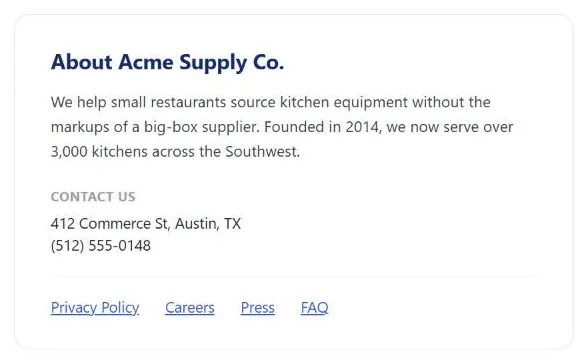 Who you are, how to reach you, and where the fine print lives — answering the trust questions a first-time visitor silently asks before they’ll commit to anything else.
Background
About Us pages exist to answer trust questions, not to promote — an organizational profile written for the company’s own internal audience (self-congratulatory, jargon-heavy) fails the same visitor a plain, customer-centered profile would satisfy.
About Us pages exist to answer trust questions, not to promote — an organizational profile written for the company’s own internal audience (self-congratulatory, jargon-heavy) fails the same visitor a plain, customer-centered profile would satisfy.
Problem
First-time visitors implicitly ask three questions before they’ll trust a site — who are you, what do you do, and why should I trust you? — and a site accumulates a lot of real but miscellaneous background material (contact details, legal notices, press coverage) that doesn’t belong on task-focused pages but still needs a discoverable home.
First-time visitors implicitly ask three questions before they’ll trust a site — who are you, what do you do, and why should I trust you?
Solution
Collect background information into About Us pages, tailored to which of the following are relevant to a given site rather than including all of them mechanically.
Describe the organizational profile
Who you are and what you do, written from the customer’s perspective rather than the company’s own internal framing, reinforcing the site’s Up-Front Value Proposition. A law firm names its practice areas; a consulting firm lists its specialties — visitors don’t already know what you do the way you do.
Provide contact information
Physical mailing address, phone, fax, email. A real street address does real work here: it’s one of the simplest signals that a company is not a fly-by-night operation, and phone/fax numbers matter for customers who need urgent help or simply prefer not to use email.
A real street address does real work here: it’s one of the simplest signals that a company is not a fly-by-night operation, and phone/fax numbers matter for customers who need urgent help or simply prefer not to use email.
Link disclaimers and legal information
Links to the Privacy Policy and terms of use, plus any site-specific rules (e.g. how fans may or may not use a brand’s trademarked material on their own sites).
List customers and partners
A list of past and current clients functions like a reference list a visitor can independently check; ask permission before naming anyone.
List employment opportunities
Open positions and internships; larger organizations often support searchable listings, smaller ones just list everything.
Share public relations material
Press releases, media coverage links or excerpts, awards, and interview contact information.
Provide investor relations material
Annual reports, regulatory filings, analyst coverage.
Describe community relations
Charitable involvement, past and future, and how to request the company’s help.
Credit the site
Attribution for the team or agency that built the site.
Link to the FAQ page
Point to Frequently Asked Questions for anything a visitor’s question touches that isn’t already answered elsewhere on this page.
Related Concepts
Patterns
- Up-Front Value Proposition
- Privacy Policy
- Page Template
- Preventing Phishing Scams
- Frequently Asked Questions
Principles
Sources
The Design of Sites: Pattern Group E — Building Trust and Credibility is this page’s sole source — the three implicit trust questions and the ten-item content checklist (organizational profile through the FAQ link) are drawn directly from the book’s E5 About Us pattern.