
Headlines and Blurbs
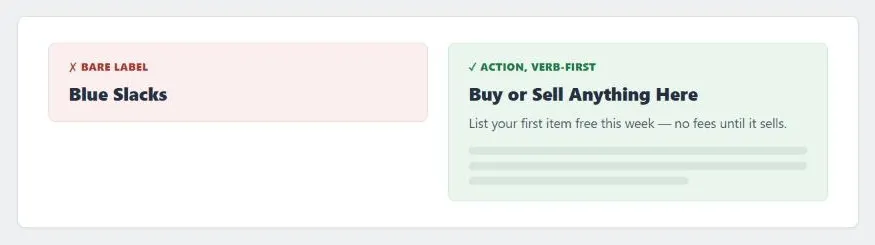 The bare label stops at a noun; the strong version pairs a verb with a promise and carries straight through into a blurb and the body it’s introducing.
Background
Headlines and blurbs are the applied, per-piece instance of the inverted-pyramid writing style: put the conclusion in the headline and the main point in the opening lines, then let supporting detail follow — see Plain Language for the general structural principle.
Problem
Visible content on any given page is only a fraction of what a site holds, so customers need some scannable promise of what lies deeper before they’ll click through to it.
Visible content on any given page is only a fraction of what a site holds, so customers need some scannable promise of what lies deeper before they’ll click through to it.
Solution
A headline and blurb pair is the hook that pulls a customer from wherever content is being promoted (a homepage, a sidebar, a search result) into the full content itself — that promise, applied consistently everywhere content is referenced.
Write the hook
Both headline and blurb should articulate why the content is important, unique, and valuable specifically to the reader — not to the site. Before writing either, work out what the reader gets from clicking through: something new, a bargain, a laugh, a connection to people with shared interests.
- Headline — a sentence fragment, roughly ten words or fewer, built for large type in a small space. A strong headline names a concrete subject and verb (a headline that implies action, like “Buy or Sell Anything Here,” outperforms a bare label like “Blue Slacks”). It also confirms what the blurb goes on to explain, and withholds enough of the story that the reader is compelled to continue rather than feeling already told everything.
- Blurb — one or two sentences continuing the headline, reinforcing the customer benefit. A blurb can be the article’s first few lines reused verbatim, or a freestanding sentence written specifically as a teaser.
A strong headline names a concrete subject and verb (a headline that implies action, like “Buy or Sell Anything Here,” outperforms a bare label like “Blue Slacks”).
Because writing a tight hook is hard, draft it long first and edit down to the essential promise — then test candidate headline/blurb pairs with real customers (three to five sets is enough to tell whether you’ve found what the audience actually values). A page’s HTML <title> can often reuse its headline directly if the headline is descriptive enough on its own — see Search Engine Optimization for how a page’s title tag is also read and weighted by search engines and reused as its search-result headline.
Store headlines and blurbs with the content
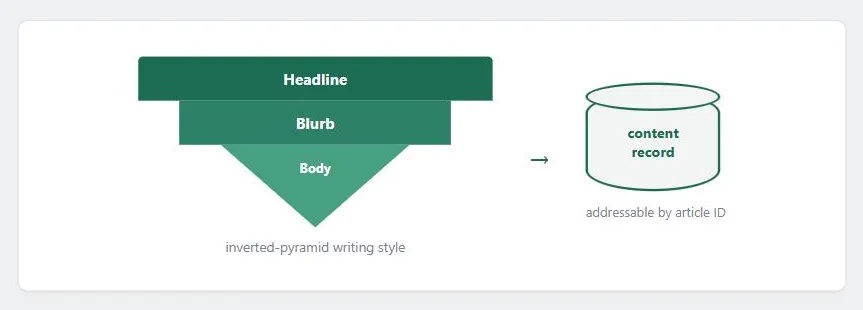 The pyramid isn’t just a writing shape — it’s also the record structure: headline, blurb, and body are stored as the same three fields the writing style already put in order.
Store the headline and blurb alongside the full article in the same content record (see Content Modules), rather than writing them only once on the page where the article lives. Because the record is addressable (e.g. by an article ID), the same headline and blurb can be looked up and displayed anywhere the content is promoted — a homepage content module, a sidebar — without duplicating text by hand. When there are only a few headlines to show, listing them in simple reverse-chronological order is enough; once there are many, group them by topic first and apply chronological order within each group (see Content Organization Schemes).
When there are only a few headlines to show, listing them in simple reverse-chronological order is enough; once there are many, group them by topic first and apply chronological order within each group (see Content Organization Schemes).
Related Concepts
Patterns
- Plain Language
- Content Modules
- Page Template
- Search Engine Optimization
- Consistent Sidebars of Related Content
- Content Organization Schemes
- Nonprofits as Networks of Help
Further reading
CXL’s roundup of microcopy case studies (cxl.com/blog/microcopy/ — copyright CXL, no open license) includes Veeam’s “Request pricing” page rewrite, which raised clicks to the lead-generation form 161.66%.
MarketingExperiments’ recap of a Michael Aagaard talk (marketingexperiments.com/email-marketing/email-optimization-a-single-word-change-results-in-a-90-lift-in-sign-ups — copyright MarketingExperiments, no open license) reports a single-word CTA change — “Start your free trial” to “Start my free trial” — producing a 90% lift in sign-ups, with the presenter noting repeat tests elsewhere landed anywhere from 30% to 90%, and that the effect didn’t replicate when tested in Danish.
Sources
The Design of Sites: Pattern Group D — Writing and Managing Content is this page’s source — its D3 Headlines and Blurbs pattern supplies the roughly-ten-word headline guideline, the verb-first “Buy or Sell Anything Here” example, and the store-with-the-content/addressable-record structure above.