
- Plan
- Explore
- Concept
- Evaluate
- Launch
GOMS
Overview
How long will a skilled user actually take to complete a given procedure on an interface?
How long will a skilled user actually take to complete a given procedure on an interface?
GOMS (Goals, Operators, Methods, and Selection rules) is a family of models, introduced by Stuart Card, Thomas Moran, and Allen Newell in their 1983 book The Psychology of Human-Computer Interaction, for predicting quantitatively how long a skilled user will take to complete a procedure on an interface — without running a live usability test. It formalizes the same “what a customer wants to do, without saying how” split Task Analysis uses for goals, then goes further by modeling the how explicitly enough to time it.
Break a task into its four components
- Goals — a state to be achieved, described independent of how it gets accomplished (the same goal/task framing as Task Analysis).
- Operators — the elementary perceptual, motor, or cognitive acts available to reach a goal (pressing a key, moving a pointer, deciding what to do next).
- Methods — a specific sequence of operators (or sub-goals) that accomplishes a goal.
- Selection rules — when more than one Method could accomplish the same goal, the rule for which one a skilled user will actually pick — the same decide-among-options problem Hick’s Law puts a number on, though GOMS treats the choice as a fixed rule already learned, not a timed decision.
Predict execution time with the Keystroke-Level Model
The Keystroke-Level Model (KLM) is the simplest variant: list the operator sequence a skilled user would perform for a task, then sum each operator’s known average time. Six operators cover most desktop interaction — K (keystroke), P (pointing), H (homing, switching between input devices), D (drawing), M (mental preparation, deciding what to do next), and R (waiting on system response) — giving Texecute = TK + TP + TH + TD + TM + TR. The P (pointing) operator’s time can itself be derived from Fitts’s Law rather than a flat average, tying KLM’s predictions back to that more general movement-time model.
This makes KLM useful for comparing two candidate designs of the same repeated task — e.g. two checkout-flow layouts — on predicted efficiency before either is actually built, complementing rather than replacing real usability testing.
A modern touchscreen adaptation, the Touch Level Model (TLM), adds Tap, Swipe, Zoom, Pinch, and Gesture operators with their own measured timings, since KLM’s original operator set assumes keyboard-and-mouse input.
Model branching tasks with CMN-GOMS and NGOMSL
CMN-GOMS, the original full model, extends KLM with real subgoals and selection rules for tasks that have more than one valid way to reach a goal (e.g. word processors, CAD software). NGOMSL re-expresses this as a structured natural-language notation and, by expanding goals hierarchically top-down, predicts learning time as well as execution time — the one variant that models how long a new user takes to pick up a procedure, not just how fast an expert can already do it.
Model overlapping expert behavior with CPM-GOMS
CPM-GOMS (Bonnie John and David Kieras) drops the assumption that operators execute one at a time, instead letting cognitive, perceptual, and motor processors run in parallel — closer to how genuinely skilled users actually behave (e.g. moving toward a target while still reading the previous screen). This variant was validated on Project Ernestine, a New England Telephone workstation redesign: CPM-GOMS predicted a 3% productivity decrease from the new design; the measured result was a 4% decrease. Critically, the analysis also correctly diagnosed why — the redesign had been built around reducing keystrokes, but the real cost was that it removed slack time skilled operators had built into their existing routine, not the keystrokes themselves.
CPM-GOMS predicted a 3% productivity decrease from the new design; the measured result was a 4% decrease.
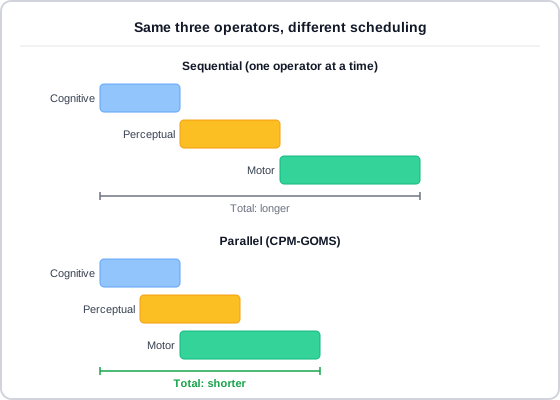 Same three operators, same individual durations — letting them overlap is where the time actually gets saved.
Use it to catch inefficiency and inconsistency before launch
Beyond timing predictions, a GOMS analysis surfaces structural problems in an interface’s own design: an industrial CAD-software redesign case study found it useful for flagging methods that were inefficient for goals users pursued often, goals that had no supported method at all, and inconsistent method choices across goals that should have worked the same way.
Know when GOMS doesn’t apply
- It models skilled, expert use only — it says nothing about a first-time or intermediate user learning the interface (NGOMSL’s learning-time prediction is the one exception).
- It ignores errors entirely, even mistakes expert users actually make.
- It ignores mental workload and fatigue.
- It assumes all users are identical — no modeling of personality, habit, or disability, though recent extensions adapt GOMS to model users with disabilities.
- It addresses usability, not functionality — whether a task can be done efficiently, not whether it’s the right task to support at all.
- Its predictions are only as accurate as the baseline operator-time data (originally sourced from Methods-Time Measurement) it’s built on.
Use it alongside, not instead of, Task Analysis (which supplies the goal hierarchy a GOMS model works from) and Usability Evaluation Methods (which confirms predictions against real users) — GOMS is at its best for catching efficiency and consistency problems cheaply, before a costly formal study is warranted.
GOMS is at its best for catching efficiency and consistency problems cheaply, before a costly formal study is warranted.
Related Concepts
Principles
Processes
Further reading
Stuart Card, Thomas Moran, and Allen Newell’s The Psychology of Human-Computer Interaction (1983, Lawrence Erlbaum Associates; amazon.com/dp/0898598591 — commercially published, no stated open license) is the original source introducing GOMS above, and also lays out the Model Human Processor — perceptual, cognitive, and motor processors, each with its own memory store and cycle time — the broader engineering model of human information-processing that GOMS’s own operator-timing approach is built on.
Sources
GOMS (Wikipedia) (CC BY-SA) is this page’s source for the Goals/Operators/Methods/Selection-rules breakdown, the Keystroke-Level Model’s six operators and formula, CPM-GOMS’s parallel-processor model, and the Project Ernestine case study’s 3%-predicted/4%-measured result above.