
Gulfs of Execution and Evaluation
Overview
Two named failure modes Donald Norman uses to describe why an interface goes wrong. The gulf of execution is the gap between what someone intends and the means actually available to do it; the gulf of evaluation is the effort needed to tell, after acting, whether it worked. Both terms predate Seven Stages of Action — coined years earlier, before The Design of Everyday Things mapped each onto that seven-stage cycle: the gulf of execution sits between forming an intention and executing an action, and the gulf of evaluation sits between executing an action and evaluating its result.
The gulf of execution is the gap between what someone intends and the means actually available to do it; the gulf of evaluation is the effort needed to tell, after acting, whether it worked.
Two failure modes
Gulf of execution — the gap between what someone intends and what the system’s actual, allowable actions are. The book’s example: a customer wants to “record this show,” which feels like it should be one action, but actually requires pressing record, setting a time, selecting a channel, and confirming — each an extra, separately-learned step the customer’s mental model of “just record it” didn’t anticipate. Additionally, printing a document consists of several actual steps — opening the print menu, selecting the right printer, checking paper or color settings, confirming — behind the one action a customer actually intended. Affordances and signifiers exist specifically to narrow this gulf, by making the allowable actions visible and obvious rather than hidden behind unmarked menus or modes.
A customer wants to “record this show,” which feels like it should be one action, but actually requires pressing record, setting a time, selecting a channel, and confirming — each an extra, separately-learned step the customer’s mental model of “just record it” didn’t anticipate.
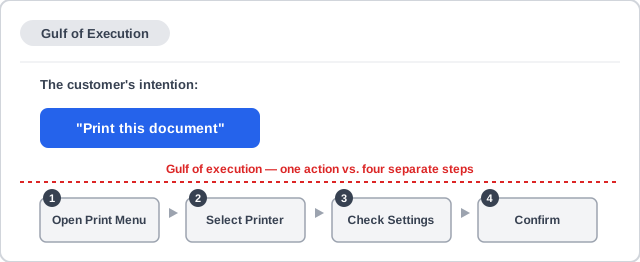 Each hidden step below the divider is a place a missing affordance or signifier would leave the customer guessing.
Gulf of evaluation — the effort needed to figure out, after acting, whether it worked: interface → perception → interpretation → evaluation. This gulf is small when a system’s state is easy to get, easy to interpret, and matches how the person already thinks about it. Norman’s own film-projector anecdote — the one that motivated his seven-stage model in the first place — illustrates both gulfs at once: the long, unclear setup sequence was a gulf of execution, and not being able to tell whether the film had been threaded correctly, even once it was in the projector, was a gulf of evaluation. Change Blindness names the specific perceptual failure that widens this gulf on a screen: a state that technically did update but wasn’t visually salient enough to register as having changed at all.
Design implications
Narrowing either gulf comes down to four principles:
- Visibility — a customer can tell, just by looking, what state the system is in and what actions are available.
- A good conceptual model — the system presents itself consistently enough that a customer can build an accurate mental picture of how it works, rather than a wrong one that leads to confident mistakes.
- Good mappings — the relationship between a control and its effect (and between system state and what’s visible) is intuitive rather than arbitrary.
- Feedback — the customer gets continuous, legible information about what just happened. This is the same principle Interface Design Principles already documents in depth (its second principle, “offer informative feedback”) — see that page for the loading-indicator and progress-display detail this article doesn’t go into.
A widened gulf of evaluation shows up in several places: it’s why Accessibility concerns compound when a system’s state is only ever communicated through one channel (a color change is no signal at all to someone who can’t perceive it), why it taxes working memory until the uncertainty about what just happened resolves, and why Notifications that fire too frequently or at the wrong moment end up reopening the very gulf they exist to close. Across a multi-step process, a journey map is what makes visible which specific phase is producing which gulf — something a single action’s per-stage framing doesn’t capture on its own.
Notifications that fire too frequently or at the wrong moment end up reopening the very gulf they exist to close.
Related Concepts
Patterns
Principles
- Seven Stages of Action
- Affordance
- Mental Models
- Interface Design Principles
- Accessibility
- Change Blindness
- Cognitive Load
Processes
Further reading
Donald Norman’s “Cognitive Engineering” (in Norman and Draper, eds., User Centered System Design: New Perspectives on Human-Computer Interaction, Lawrence Erlbaum Associates, 1986, pp. 31–61 — commercially published, no stated open license) is the actual chapter that introduced both gulfs — developed with Jim Hollan and Ed Hutchins during the book’s drafting, the specific origin the Wikipedia source below only dates as “predating the book itself” without naming.
Sources
The Design of Everyday Things (Wikipedia) is this page’s sole source — both gulfs’ definitions, their origin predating the book itself, the VCR gulf-of-execution example, the projector anecdote illustrating both gulfs at once, and the four design principles that narrow them.