
Location-Based Services
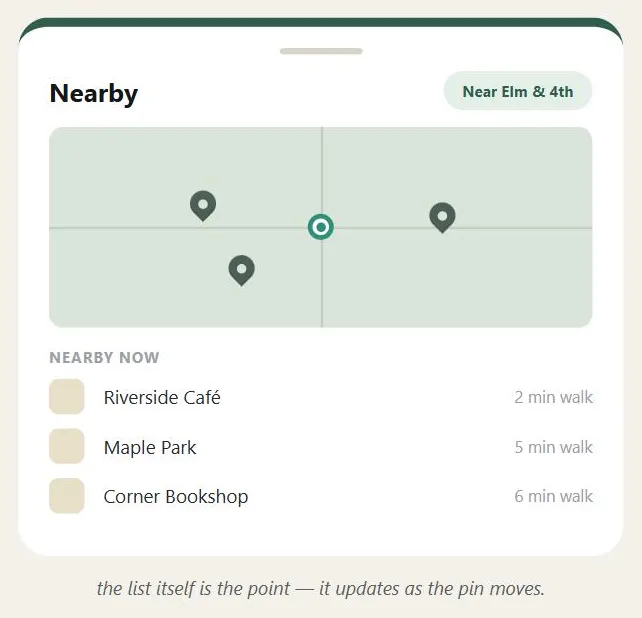 The list isn’t built from a stated preference or an inferred history — it’s simply the answer to “what’s close to where I am right now.”
Background
Automatic disclosure (sharing location without a fresh request each time) is more convenient than requiring an explicit ask, but it’s also more prone to socially awkward or ill-timed reveals. A customer’s location shared automatically at the wrong moment can expose more than they intended, even when the underlying feature is one they genuinely wanted. Defaulting to explicit requests trades some convenience for predictability and customer comfort.
Automatic disclosure (sharing location without a fresh request each time) is more convenient than requiring an explicit ask, but it’s also more prone to socially awkward or ill-timed reveals.
Problem
A customer’s mobile device increasingly knows where they physically are, but most sites still treat every visitor identically regardless of location — missing a class of genuinely new capability that has no direct desktop equivalent, and one that’s easy to design badly if privacy isn’t considered from the outset.
A customer’s mobile device increasingly knows where they physically are, but most sites still treat every visitor identically regardless of location — missing a class of genuinely new capability that has no direct desktop equivalent, and one that’s easy to design badly if privacy isn’t considered from the outset.
Solution
A location-based service tailors what a customer sees or can do based on their current physical location, using positioning data from a mobile device. It’s the physical-location instance of the general Personalized Content pattern: instead of targeting content by stated preferences or browsing history, it targets by where the customer actually is right now.
A location-based service tailors what a customer sees or can do based on their current physical location, using positioning data from a mobile device.
Common application types
- Exploration and navigation guides — the most common use: showing nearby points of interest, directions, or a map-based search-results view filtered to what’s physically close. A design worth deliberately supporting is serendipitous exploration as an alternative to an exhaustive, omniscient map — letting a customer discover a place “on approach” rather than seeing everything laid out in advance, for the customer who specifically doesn’t want a fully preplanned route.
- Location-tagged content — automatically attaching location metadata to content a customer creates (photos, notes) so it can later be found by where it was made, and letting customers attach their own content to a place — a message board scoped to a physical location instead of a topic.
- Social coordination — showing customers where their friends or family are, either on explicit request or by automatic disclosure. Explicit requests are generally more comfortable for customers than automatic disclosure, which can produce socially awkward moments (a notification firing at an inconvenient time reveals more than the customer meant to share in that moment).
- Location-aware games — layering a game over the physical world, from geocaching (hiding and finding physical caches, logged by GPS coordinates on a companion site) to more elaborate augmented-reality formats; a location-flavored instance of Stimulating Arts and Entertainment.
- Fleet and asset tracking — real-time location for vehicles or equipment, used for routing, arrival notifications, and geofenced alerts when an asset enters or leaves a defined area.
Design for privacy from the start
Location data is unusually sensitive because it’s continuously generated and easy to misuse — between employers and employees, parents and teens, or any relationship with a power imbalance. Build in a clear Privacy Policy, follow Fair Information Practices, and let customers set their own Privacy Preferences before launch, not after — location-based services are difficult to retrofit with privacy protections once customers are already using them without that assurance.
Privacy here isn’t just secrecy: customers routinely want to share their location selectively and manage which persona different audiences see (a more guarded, “professional” self at work; a more relaxed one with close friends), so a location-sharing feature needs to support deliberate, controllable disclosure rather than an all-or-nothing broadcast.
Connection to other patterns
Location-based services are one of the clearest cases where mobile-specific design unlocks genuinely new capability rather than just shrinking an existing experience — a service tied to the customer’s real-time location has no direct desktop equivalent. They can also draw on Multiple Ways to Navigate when location becomes one more axis (alongside time, category, or keyword) for browsing tagged content.
Related Concepts
Patterns
- Personalized Content
- Organized Search Results
- Message Boards
- Stimulating Arts and Entertainment
- Multiple Ways to Navigate
- Privacy Policy
- Privacy Preferences
- Mobile Screen Sizing
Standards
Sources
The Design of Sites: Pattern Group M — The Mobile Web (Pattern M3, Location-Based Services) is this page’s sole source — the automatic-vs-explicit-disclosure background trade-off, the five application-type categories, and the privacy-designed-in-from-the-start guidance.