
Blogs
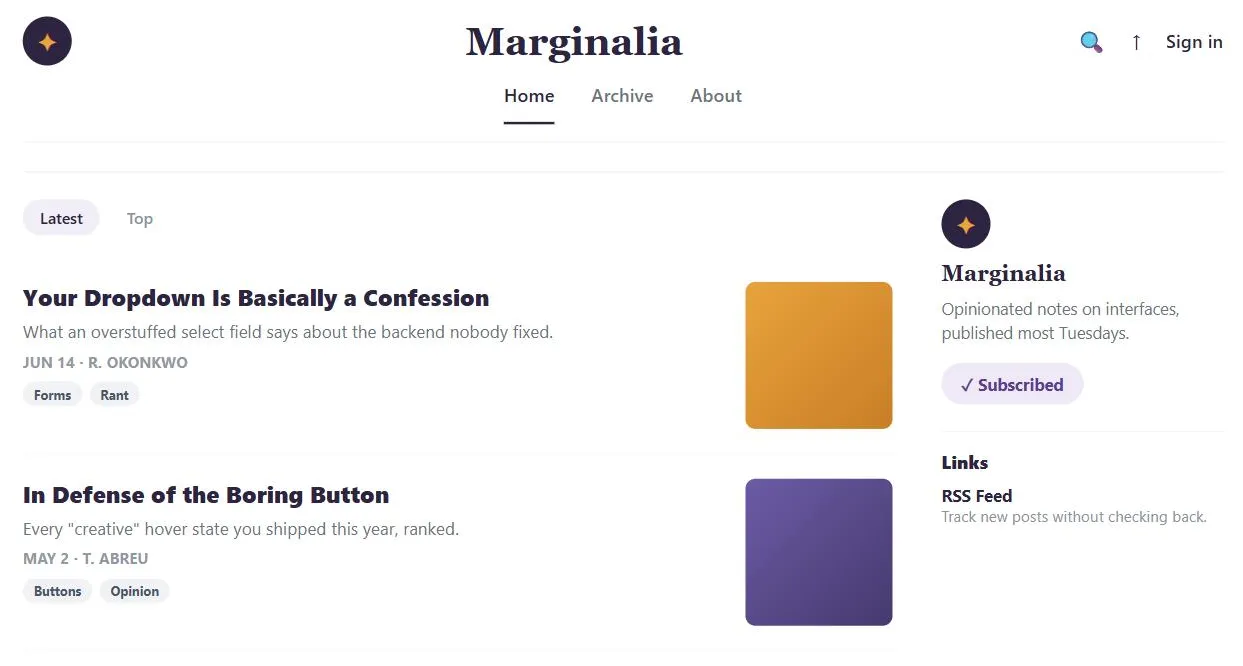 Two different named writers make this a group blog rather than a single voice, and the dated, tagged posts with an RSS link are the findability tools that substitute for a “check back later” habit.
Problem
A blog — in its simplest form just a Web page of dated entries — succeeds or fails on one thing: whether it attracts a readership that keeps coming back, and generic, undifferentiated writing gives a reader no reason to return.
A blog — in its simplest form just a Web page of dated entries — succeeds or fails on one thing: whether it attracts a readership that keeps coming back, and generic, undifferentiated writing gives a reader no reason to return.
Solution
Adapt the blog format (dated entries, a distinctive voice, tags and RSS for findability) to whatever site genre or purpose it’s serving. That single requirement — attracting a returning readership — is why blogs adapt to almost any other site genre (company sites, news sites, grassroots sites, intranets, and as the basis for a community conference) rather than being a genre unto itself with fixed content.
Establish credibility
The same trust and credibility considerations that apply to any site apply to blogs, adapted to an individual voice: an About Us-equivalent background section for a personal or corporate blogger, honest engagement with criticism (harder for corporate and product blogs than personal ones), and consistently fresh, genuinely distinctive content — none of which substitutes for the harder-to-fake ingredient of a writer who actually has sharp, unique insight and cares about the topic.
Serve any genre and audience
Blogs serve product marketing (behind-the-scenes development diaries, launch buzz), company communication (executive or team blogs reinforcing brand voice), news aggregation (curating or voting on external stories), arts/entertainment, grassroots advocacy, and internal team communication on an intranet — the same content, in other words, that the rest of this pattern group treats as separate site genres, just delivered through the blog format instead of a bespoke site structure.
Cultivate a distinctive voice, not just correct writing
Unlike news writing, a blog’s writing doesn’t have to follow an inverted-pyramid structure — it has to be distinctive rather than merely correct. A sharp, consistent voice (satirical, authoritative-and-provocative, wisecracking) is what turns a blog into something people choose to read regularly, as opposed to an undifferentiated stream-of-consciousness (“bloghorrea”) that gives a reader no reason to return.
A sharp, consistent voice (satirical, authoritative-and-provocative, wisecracking) is what turns a blog into something people choose to read regularly, as opposed to an undifferentiated stream-of-consciousness (“bloghorrea”) that gives a reader no reason to return.
Choose an ownership model
Blogs split into three operating models with different tradeoffs:
- Individual — easiest to start, and best suited to a single strong voice or advocacy position.
- Group — a small team of several named contributors spreads the workload and adds range while staying editorially coherent.
- Community — the readership itself is the primary source of new posts, which generates far more content and traffic but requires real moderation investment and, often, a cost-offsetting mechanism (a small joining fee, advertising, paid subscriptions) to stay sustainable at scale.
Decide whether to allow comments
Allowing reader comments (via Message Boards attached to each entry) is a real tradeoff, not a default: it builds community and surfaces useful feedback, but it also invites spam (sometimes automated) and exposes the blogger to direct, public criticism — enough of a cost that some sites have shut down blog comments entirely after sustained abuse. Community blogs are the exception, since their readers already expect to be co-authors rather than passive commenters.
Make a blog findable
The same search-engine writing and title-writing discipline that applies to any content applies to blog posts, plus two blog-specific tools: tags (short topical labels on each entry) make posts on one theme findable, though getting a whole community to agree on consistent tag spelling and granularity is genuinely hard once many people are tagging independently; and an RSS feed lets readers track new posts without visiting the site directly, and lets other sites syndicate a blog’s content outward — both effectively substitutes for a permalink-based “check back later” habit.
Related Concepts
Patterns
- About Us Pages
- Message Boards
- Search Engine Optimization
- Community Conference
- Valuable Company Sites
- News Mosaics
- Grassroots Information Sites
- Enabling Intranets
- Nonprofits as Networks of Help
- Permalinks
Principles
Sources
The Design of Sites: Pattern Group A — Site Genres is this page’s sole source — the A12 Blogs pattern’s genre-flexibility argument, the individual/group/community ownership spectrum, the comments tradeoff, and the tags/RSS findability tools are what this page documents directly.