
Up-Front Value Proposition
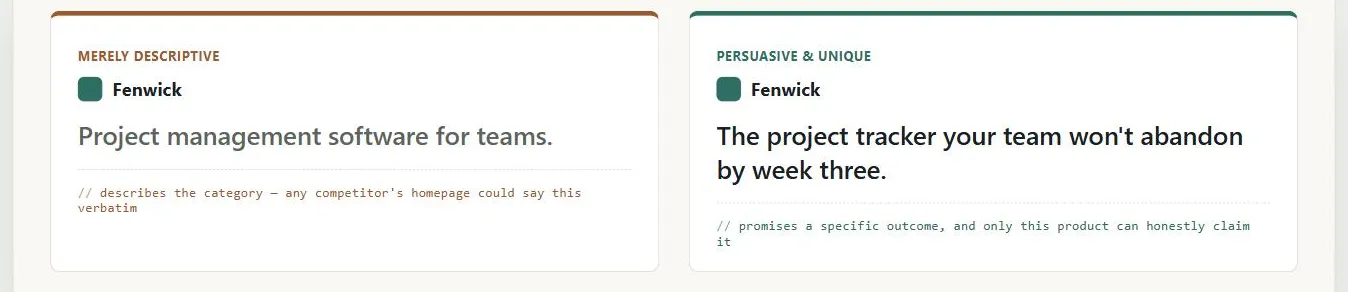 A merely descriptive line answers “what category is this” — the bar here is answering “why this one, and not any of its competitors.”
Background
This pattern fleshes out the “decide on the value proposition” step named in the Discovery phase of Web Site Development Process. Once chosen, integrate it tightly with site branding so it reads as a single, fast first impression rather than two competing messages — see Homepage Portal.
Problem
Visitors who can’t immediately tell what a site or company offers will often leave rather than dig for the answer, and a wrong or absent first impression takes expensive, slow trust-rebuilding to undo later.
Visitors who can’t immediately tell what a site or company offers will often leave rather than dig for the answer, and a wrong or absent first impression takes expensive, slow trust-rebuilding to undo later.
Solution
State a persuasive, unique promise — what the site offers and why it’s worth a visitor’s time — as one of the first things read on the Homepage Portal, typically right next to the logo so it’s read alongside it. The bar (citing David Ogilvy’s advertising principle that a persuasively-promised unique benefit gets read and acted on more) is that the statement must be both persuasive and unique, not simply descriptive.
The bar (citing David Ogilvy’s advertising principle that a persuasively-promised unique benefit gets read and acted on more) is that the statement must be both persuasive and unique, not simply descriptive.
A repeatable four-step process for arriving at one:
- Brainstorm — get the whole design team in a room (especially its most visionary/vocal members) and generate candidate ten-word-or-fewer promises with no judgment or filtering in the moment.
- Shortlist — have a smaller group of marketing/business stakeholders narrow the brainstormed list to the ten strongest candidates, screened against strategic fit, persuasiveness, and uniqueness.
- Customer-rate — survey a sample of customers (around 100) to rate each of the ten on importance (0–10) and uniqueness (0–10); keep only candidates averaging 7+ on both. If none clears that bar, the brainstorming step needs another pass.
- Customer-select — survey customers again to pick a single winner from the survivors.
If none clears that bar, the brainstorming step needs another pass.
Related Concepts
Patterns
Processes
Further reading
Optimizely’s account of the Obama 2008 campaign’s landing-page test (optimizely.com/insights/blog/how-obama-raised-60-million-by-running-a-simple-experiment/ — copyright Optimizely, no open license) describes a 24-combination test of four button labels against six images/videos across 310,382 visitors; the winning “Learn More” button paired with a family photograph raised the sign-up rate 40.6%, attributed to roughly $60 million in additional donations over the campaign — a real-world instance of the customer-rate/customer-select testing steps above, just run through live A/B testing rather than a survey.
Sources
The Design of Sites: Pattern Group C — Creating a Powerful Homepage is this page’s C2 pattern source — the persuasive-and-unique bar for a value proposition (citing David Ogilvy) and the four-step brainstorm/shortlist/customer-rate/customer-select process for arriving at one.