
Unified Browsing Hierarchy
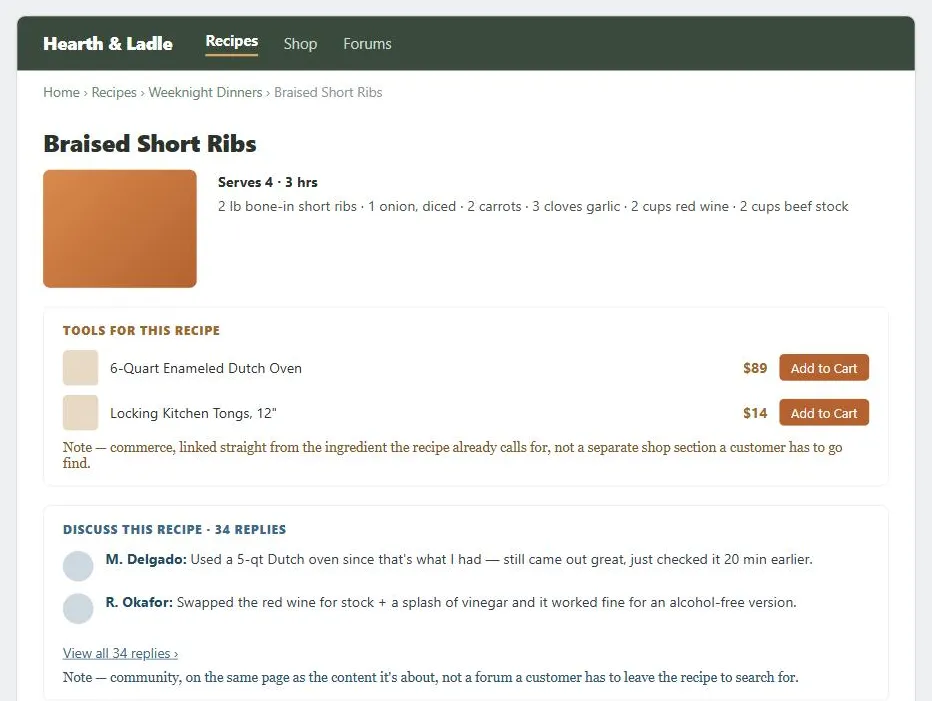 Content, commerce, and community about the same short ribs recipe are all reachable without a single trip back through the homepage.
Background
A unified hierarchy is what makes cross-selling between content and commerce possible in the first place — a customer can’t be pointed from an article to a related product if the two are never linked. Where sections can’t be fully integrated on one page, give customers direct access to each from a navigation bar or a sidebar, and use location breadcrumbs so customers always know which section they’re currently in as they move between them.
Problem
A site that offers content, commerce, and community around the same topics — a cooking site with recipes (content), a shop for kitchen tools (commerce), and a discussion forum (community). That combination makes each section harder to find than it should be if the only way between them is back through the homepage. Customers interested in all three have to leave a section entirely, return home, and navigate back down a different branch; some won’t bother, and will never discover that the other sections exist at all.
That combination makes each section harder to find than it should be if the only way between them is back through the homepage.
Solution
Integrate the site’s distinct sections into one unified hierarchy instead of three isolated ones.
Cross-link related material across separate sections
Keep content, commerce, and community as separate sections reachable from the homepage, but add links between related material in each — a recipe page linking to the tools it calls for; a product page linking to a forum thread about it.
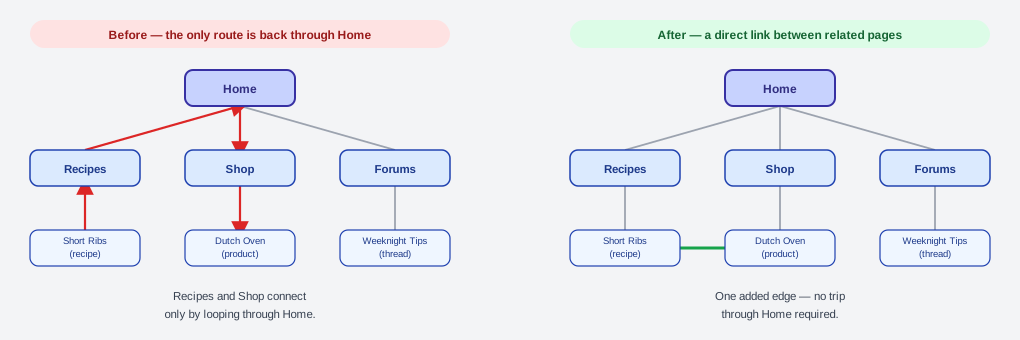 The site’s tree doesn’t change — Recipes, Shop, and Forums stay separate branches — but one new edge lets a customer cross between two leaves without detouring back through Home.
Combine related elements onto one page
Place two or three of the related elements together — a recipe alongside the tools it needs and a link to discuss it — so a customer never has to leave the page to get the full picture. Either approach requires someone with the authority and time to own the cross-linking work across sections that may be written and maintained by different people — without an owner, the sections drift back apart as new content is added to each independently.
Either approach requires someone with the authority and time to own the cross-linking work across sections that may be written and maintained by different people — without an owner, the sections drift back apart as new content is added to each independently.
Related Concepts
Patterns
- Multiple Ways to Navigate
- Navigation Menus
- Breadcrumb Navigation
- Consistent Sidebars of Related Content
- Cross-Selling and Up-Selling
Sources
The Design of Sites: Pattern Group K — Making Navigation Easy is this page’s K1 pattern source — cross-linking a site’s content, commerce, and community sections (or combining them on one page) instead of forcing navigation back through the homepage.