
Nonprofits as Networks of Help
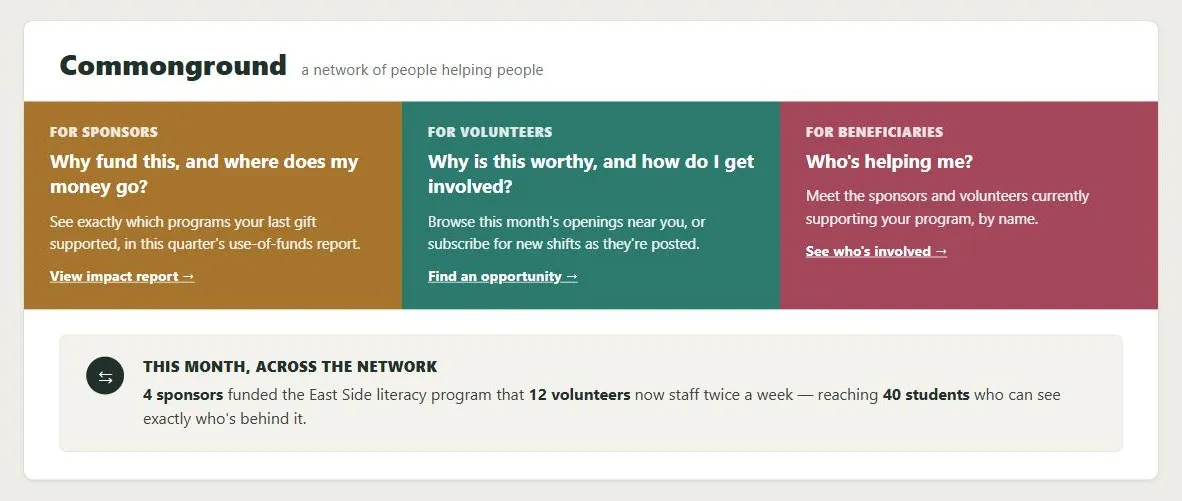 Three panels answer three different questions, but the shared box beneath them is the actual point: sponsors, volunteers, and beneficiaries seeing the same coordinated update is what makes this a network rather than three separate informational pages.
Background
This is the same network-effect logic the source applies again to Educational Forums and community conferences — a nonprofit site is one specific domain it shows up in, not a nonprofit-specific idea.
This is the same network-effect logic the source applies again to Educational Forums and community conferences — a nonprofit site is one specific domain it shows up in, not a nonprofit-specific idea.
Problem
A nonprofit site serves several distinct groups at once — financial sponsors, volunteers, staff, and beneficiaries — each with different questions and different reasons to be there, all coordinated around the same underlying projects; answering “the basics” for each group in isolation captures only part of the Web’s value.
A nonprofit site serves several distinct groups at once — financial sponsors, volunteers, staff, and beneficiaries — each with different questions and different reasons to be there, all coordinated around the same underlying projects; answering “the basics” for each group in isolation captures only part of the Web’s value.
Solution
The bigger opportunity is connecting these groups directly to one another so the site functions as an actual coordination network, not just an informational one.
What each group needs
| Group | Typical question | What answers it |
|---|---|---|
| Financial sponsors | Why fund this, and how is my money used? | An About Us overview, beneficiary stories, use-of-funds statistics, a secure donation Process Funnel |
| Volunteers | Why is this worthy, how do I get involved? | Program overview, volunteer stories, an event schedule, an email subscription for nearby events |
| Staff | Who’s currently participating? | A secure directory of volunteers, sponsors, and beneficiaries |
| Beneficiaries | Who’s helping me? | Visible acknowledgment of the people and organizations supporting them |
| Everyone | What’s new? | Content Modules and Headlines and Blurbs about current projects |
Build the network effect
Give these groups tools to talk directly to each other — Message Boards, Blogs, shared project calendars, content-management tooling — instead of routing every exchange of information through staff. This is what creates a genuine network effect: each additional connected person increases the network’s value for everyone already in it, since coordination and cross-group visibility compound rather than merely add up.
This is what creates a genuine network effect: each additional connected person increases the network’s value for everyone already in it, since coordination and cross-group visibility compound rather than merely add up.
Basic vs. advanced sites
A basic site answers each group’s questions on separate, well-organized pages, keeps its project calendar current, and gives volunteers a clear form and process funnel for signing up.
An advanced site goes further:
- Accepts donations through an online checkout instead of an offline process
- Qualifies volunteers for specific projects through their own sign-up funnel
- Gives signed-in project participants a personalized project workspace
- Feeds the public site excerpted progress reports pulled from the same content modules the private project team uses internally — one publishing pipeline serving both audiences instead of two separate ones
Related Concepts
Patterns
- Message Boards
- Blogs
- Content Modules
- Headlines and Blurbs
- About Us Pages
- Email Communications
- Quick-Flow Checkout
- Process Funnel
- Form Design
- Personalized Content
- Community Conference
- Educational Forums
Sources
The Design of Sites: Pattern Group A — Site Genres is this page’s sole source, its A5 pattern — the four-stakeholder (sponsors/volunteers/staff/beneficiaries) needs table and the network-effect case for connecting those groups directly rather than serving each in isolation.