
Progressive Disclosure
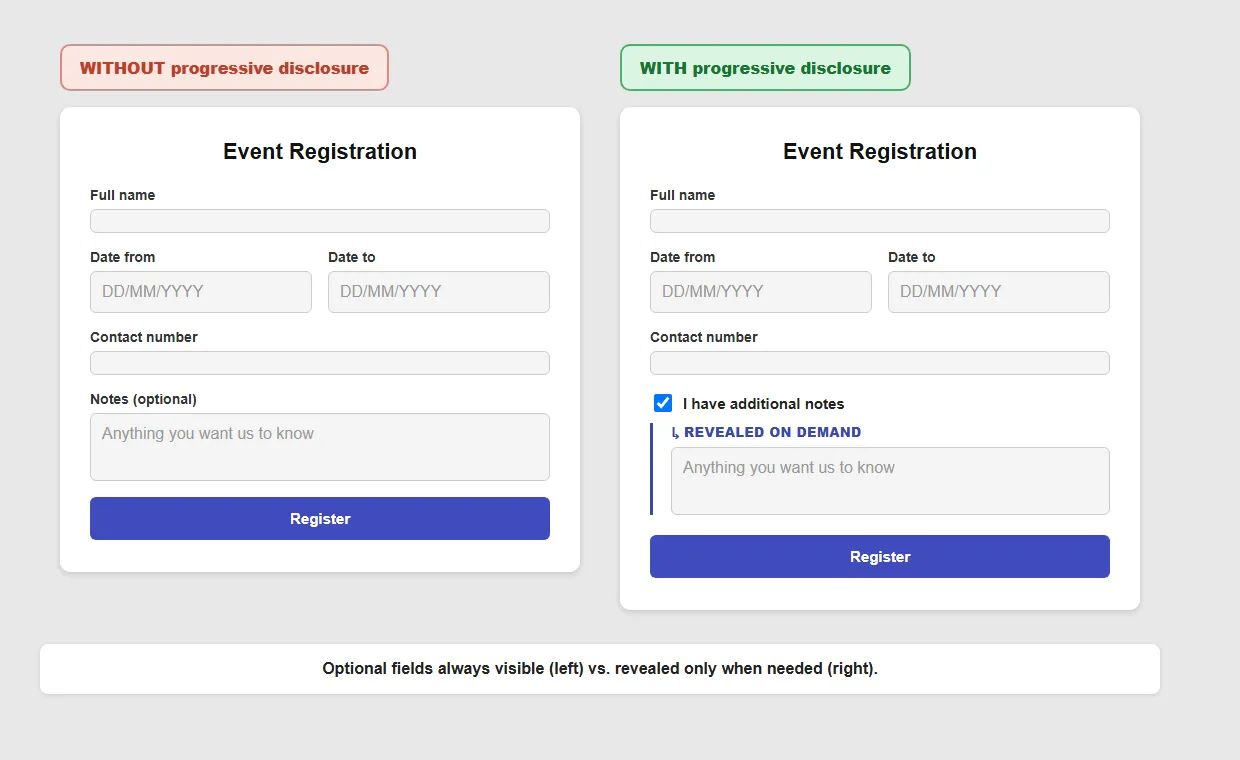 The optional Notes field stays out of the way until the checkbox reveals it, keeping the default form shorter.
Background
Progressive disclosure shifts cognitive cost rather than eliminating it. Content hidden behind a “show more” link is less findable for users who don’t know to look for it. Applied carelessly, it can frustrate expert users who already know what they need and have to take extra steps to reveal it. The tradeoff is between a cleaner default state (benefiting novices and occasional users) and a more efficient expert experience (which may benefit from having more exposed at once). Interfaces that serve a wide ability range often need both paths.
Progressive disclosure shifts cognitive cost rather than eliminating it.
Problem
Showing every option or piece of information at once overwhelms users. More choices slow decisions logarithmically (Hick’s Law), and once the number of simultaneous items exceeds roughly four to seven, people can no longer hold them all in working memory.
Solution
Progressive disclosure is the practice of presenting only the information or choices necessary for the current step, revealing additional detail when it becomes relevant to the task at hand. The goal is to reduce Cognitive Load at each decision point without removing options — the full capability remains available, deferred until the user actually needs it. This is the same idea Information Architecture‘s “principle of disclosure” names at the level of a whole site’s categories, not just one page’s form fields: show just enough to help someone decide whether to dig deeper.
Rationale
Two mechanisms explain why progressive disclosure works. First, Hick’s Law: decision time grows logarithmically with the number of choices presented simultaneously. Showing fewer choices at once reduces the immediate decision load even when the total number of options is unchanged. Second, working memory: people can hold roughly four to seven items in active attention at once; an interface that presents more than that simultaneously forces users to mentally track things rather than decide among them.
People can hold roughly four to seven items in active attention at once; an interface that presents more than that simultaneously forces users to mentally track things rather than decide among them.
Progressive disclosure doesn’t solve these problems by removing content — it solves them by timing content appropriately. A secondary option that never shows until it’s needed is both less cognitively expensive and easier to find when it is needed, because it has no other options to compete with.
The principle extends beyond digital interfaces. Theme park queue designers use it physically: rather than making the full length of a long ride queue visible at once (which would discourage visitors from joining), only a short segment is visible from any vantage point. As visitors advance, the next segment reveals itself. The same underlying logic applies — the total length hasn’t changed, but exposure is metered to reduce the perceived burden at each moment.
Common applications
- Navigation menus — a top-level navigation shows categories; subcategories appear on hover, click, or drill-down rather than all at once. The hierarchical structure is itself a progressive-disclosure arrangement: each level is revealed only after the level above has been traversed.
- Above-the-fold / below-the-fold layout — Above the Fold content presents the essential decision elements first; detail is disclosed below as the user scrolls. A product details page is a canonical instance: purchase-critical information above the fold, full specifications and reviews below it.
- Multi-step forms and funnels — a Process Funnel reveals each step in sequence rather than presenting the entire form at once. A checkout flow breaks the overall task into four steps (account, shipping, payment, confirmation), each presenting only what’s needed for that stage.
- “Show more” and “Advanced options” — interfaces that hide secondary or expert-level controls behind an expandable section present a simpler default state without removing capability for users who need it.
- Progressive loading — content rendered incrementally as it arrives, rather than blocking until everything is ready, is a temporal form of progressive disclosure (see Loading States).
- First-use empty states — an empty state for a primary feature can link out to fuller in-line documentation rather than front-loading all of it into the empty state’s own body text, deferring the extra detail until someone actually asks for it.
Relationship to the 95/5 rule
Homepage Portal‘s 95%/5% rule — dedicating most Above the Fold space to the dominant audience’s needs and surfacing rarer needs on a subsidiary page — is a concrete instance of progressive disclosure applied to homepage design. The principle is the same: present the common case prominently; disclose the uncommon case on demand rather than cluttering the primary view with it.
The principle is the same: present the common case prominently; disclose the uncommon case on demand rather than cluttering the primary view with it.
Related Concepts
Patterns
- Above the Fold
- Loading States
- Homepage Portal
- Form Design
- Multiple Ways to Navigate
- Clean Product Details
- Process Funnel
- Quick-Flow Checkout
- Navigation Menus
- Empty States
Principles
Further reading
ReForm: Free Chapters and Tips (reform.user-interface.io — ungated PDF, no stated open license) demonstrates progressive disclosure applied specifically to forms: optional sections are hidden by default and revealed only when the user checks a corresponding checkbox, at which point the revealed section becomes required rather than optional. The worked example is a hotel booking form with optional “Special Requirements” and “I want to be picked up” sections.
Sources
Hick's Law (Wikipedia) is the source for the Rationale section’s claim that decision time grows logarithmically with the number of simultaneous choices — the mechanism behind why showing fewer options at once reduces immediate decision load.
Progressive disclosure (Wikipedia) (CC BY-SA 4.0) is the source of the theme-park-queue analogy in Solution — only a short segment of a long queue is visible at a time, mirroring how progressive disclosure meters exposure rather than shortening the underlying total.