
News Mosaics
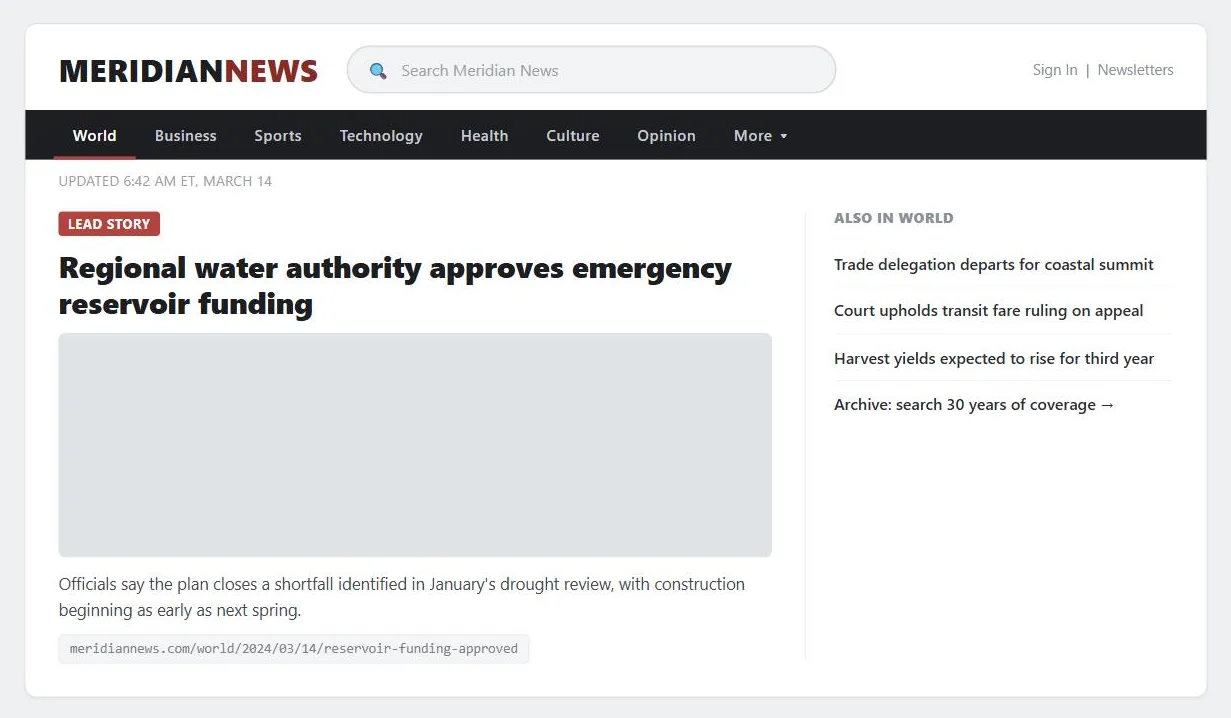 One homepage doing three jobs at once: multiple ways in for breadth (search, categories), a lead story for depth, and a dated, durable permalink that turns today’s story into tomorrow’s searchable archive.
Problem
Web news operates under different constraints than broadcast or print. Readers skim rather than read closely and abandon quickly if a story doesn’t hook them, content could either vanish after a day or accumulate as a searchable archive, and over-tailoring coverage per reader risks fragmenting an audience into narrow interest silos instead of sharing common context.
Readers skim rather than read closely and abandon quickly if a story doesn’t hook them, content could either vanish after a day or accumulate as a searchable archive, and over-tailoring coverage per reader risks fragmenting an audience into narrow interest silos instead of sharing common context.
Solution
A news mosaic is a site genre built around delivering breadth and depth of news coverage: many categories and subcategories, a highlighted lead story within each, and a permanent, searchable historical archive rather than content that ages out after a day. The name captures the goal — many pieces (stories, media types, time periods) assembled into one coherent picture, rather than a single linear feed.
What the Web changes about news
Compared to TV, radio, and print, Web news differs along three axes:
- Time and access — broadcast and print news is ephemeral (today’s news is tomorrow’s archive, if it’s kept at all); Web news can stay accessible and searchable indefinitely, so a news site’s database has ongoing value as both current news and historical record. Publishing pressure is real (avoid hand-recreating page layout for every story — see Page Template and Content Modules), and so is source-checking pressure, since Web readers perceive articles as more credible when references and attributions are linked (Embedded Links, External Links).
- Form — the Web can blend TV’s brevity, radio’s portability, and print’s depth and space, but people skim online rather than reading closely, and abandon quickly if a story doesn’t hook them. Counter this with a strong clear first read and inverted-pyramid writing that front-loads the point, then use Embedded Links or a sidebar to link out to supplementary video, audio, or a richer image set instead of cramming every medium onto one page.
- Audience — unlike broadcast/print’s fixed demographic reach, Web news can be tailored per reader. This is double-edged: over-tailoring risks a “Balkanization” of information (a term from a review by Andrew Shapiro) where readers self-select into narrow interest silos and lose the shared context a broad audience used to get from one broadcast. A news site’s editorial job is still to surface high-quality stories readers don’t know they want, not only the ones they’d explicitly ask for.
This is double-edged: over-tailoring risks a “Balkanization” of information (a term from a review by Andrew Shapiro) where readers self-select into narrow interest silos and lose the shared context a broad audience used to get from one broadcast.
Structure for breadth and depth
Build breadth through categories and subcategories, and depth by leading each category with its most important story and lead text while still surfacing secondary stories that a “most popular only” ranking would bury. Within an article, put the summary first for people who want a quick read, with full depth available below it. Support search, Predictive Input, and multiple browsing paths (category, keyword, historical/date) since readers arrive wanting different levels of engagement.
Commit to durable archives and permalinks
Archiving stories in a stable, consistent location is what makes a news site useful as a historical record, not just a headline feed — but few sites actually commit to durable per-story addresses.
Archiving stories in a stable, consistent location is what makes a news site useful as a historical record, not just a headline feed — but few sites actually commit to durable per-story addresses.
Offer subscription and personalization options
Advanced news mosaics can offer email subscriptions to specific topics, or gate premium coverage behind sign-in and a paid subscription checkout — layering Personalized Content and standard account/checkout patterns on top of the base news-mosaic structure rather than replacing it.
Related Concepts
Patterns
- Page Template
- Content Modules
- Headlines and Blurbs
- Plain Language
- Clear First Reads
- Embedded Links
- Consistent Sidebars of Related Content
- Permalinks
- External Links
- Organized Search Results
- Predictive Input
- Search Engine Optimization
- Blogs
Sources
The Design of Sites: Pattern Group A — Site Genres is this page’s sole source, its A2 pattern — the time/form/audience axes distinguishing Web news from broadcast/print, the Balkanization risk from over-personalized coverage, and durable permalinks as an underused differentiator.