
- Plan
- Explore
- Concept
- Evaluate
- Launch
Contextual Inquiry
Overview
How do you find out what people actually do, rather than what they remember or say they do?
How do you find out what people actually do, rather than what they remember or say they do?
A structured field-research technique for understanding how people actually work: the researcher visits a user’s own environment — home, workplace, or wherever the activity normally happens — and alternates between observing a real task and discussing it as it unfolds, rather than reconstructing it afterward from memory in an interview room. It’s a more rigorous, principle-driven version of the general ethnographic observation covered in Customer Research Methods, and its data-gathering visit is only half the technique — a separate interpretation session afterward is what turns what was observed into something the rest of a team can act on.
Follow Four Guiding Principles
Four principles structure a session, distinguishing it from an unstructured visit or a plain interview:
- Context. Conduct the session in the user’s actual environment, working with the real artifacts, tools, and documents involved, and asking about specific past events rather than general habits.
- Partnership. Treat the user as a collaborator in understanding their own work, not a subject being studied — the session alternates between watching an action and discussing why it happened, rather than one long unbroken observation.
- Interpretation. Share a developing understanding with the user during the session itself, so it can be corrected or expanded on the spot, rather than only checking assumptions after the fact.
- Focus. Steer the conversation toward what the project actually needs to learn — a contextual inquiry is guided, not a fully open-ended visit.
Structure the Visit in Three Phases
- Introduction. Introduce yourself and the purpose of the visit, ask permission to record, promise confidentiality, and get a general overview of the person’s work before identifying the specific task or tasks to focus on.
- Body. Observe the task as it happens and discuss it in the moment, capturing notes by hand rather than relying on recall afterward.
- Wrap-up. Summarize what was observed back to the user, giving them a chance to correct or add to it before the visit ends.
Plan the Visit Logistics
A visit typically runs one to three hours; because sustained observation is demanding for the researcher, plan no more than four one-hour visits or two three-hour visits in a single day. How many visits a project needs scales with its scope: as few as four users for a single narrow task, up to thirty or more for a broad inquiry across many roles or contexts.
Send two researchers per visit rather than one — one leads and engages the participant while the other takes notes and manages recording, which is both safer and catches more than a single researcher would alone. Write a shared discussion guide (an introduction script, the planned visit structure, a pre-visit checklist) so multiple researchers running separate visits still gather comparable data, and plan for accessibility in the visit format itself — a participant with a disability, or one who needs support to take part, should be as well accommodated as the task being observed.
Send two researchers per visit rather than one — one leads and engages the participant while the other takes notes and manages recording, which is both safer and catches more than a single researcher would alone.
Before departing, confirm the address, contact details, and appropriate dress for the setting; on arrival, gather background information and secure informed consent; during the visit itself, stay flexible and minimize interference while clarifying anything unclear as it comes up; close with follow-up questions and a chance for the participant to react to how the visit went.
Choose an Observation Style
How actively the researcher participates during the body of the visit sits on a spectrum, from silent observation, to occasionally asking questions, to having the participant narrate their own actions as they go. The choice trades authenticity against understanding: a more hands-off style risks missing the reasoning behind an action, while a more active style risks changing the very behavior being observed by asking about it.
The choice trades authenticity against understanding: a more hands-off style risks missing the reasoning behind an action, while a more active style risks changing the very behavior being observed by asking about it.
Consolidate Findings in an Interpretation Session
The field visit isn’t the end of the technique — a separate interpretation session, typically with 3–8 people from the team, is where the interview gets retold and other members add their own insights. What the group builds from that retelling takes one of five named shapes, each capturing a different facet of the work observed: a flow model (who coordinates and communicates with whom, and in what role), a sequence model (the steps taken to complete an activity, including where it broke down), a cultural model (the norms and pressures the surrounding organization or environment placed on the work), an artifact model (the documents and physical objects the work created or relied on), and a physical model (the spatial environment the work happened in). Building one of these is often the same Affinity Diagramming process used elsewhere to turn raw research into structure, applied here to contextual-inquiry notes specifically rather than general interview data.
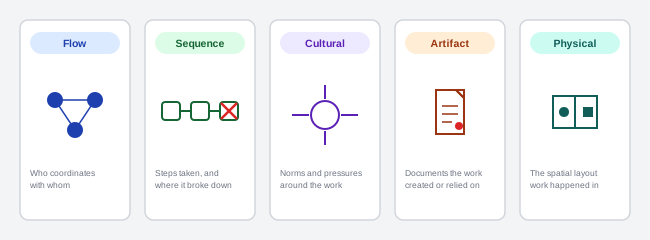 Five different lenses on the same visit — none of them a transcript, all of them something the rest of the team can act on without having been there.
Where This Leads
Contextual inquiry sits alongside shadowing, guided tours, and intercept interviews as one more way to gather the observational half of Customer Research Methods — it’s the most structured of the group, trading speed for the principled discipline of the four guiding principles and a dedicated interpretation session. The photos, quotes, and video captured during a visit, and the work models built afterward, commonly feed into a journey map the same way other customer-research output does.
Related Concepts
Processes
Further reading
Hugh Beyer and Karen Holtzblatt’s Contextual Design: Design for Life (2nd edition; amazon.com/dp/0128008946 — Morgan Kaufmann/Elsevier, 2016, commercially published, no stated open license) is the full-length primary source behind the five work models this page only names — developed through the authors’ original Contextual Design methodology, of which contextual inquiry is the data-gathering first step, along with the six further steps (interpretation, data consolidation, visioning, Storyboarding, user environment design, prototyping) that carry the work models through to an actual design.
Sources
Contextual Inquiry (Wikipedia) (CC BY-SA 4.0) supplies the four guiding principles, the three-phase visit structure, the interpretation-session concept, and the sample-size guidance.
Contextual Research and Observation (GOV.UK Service Manual) (Open Government Licence v3.0) supplies the practical execution guidance — session-length and daily-visit limits, pair research, the discussion guide, the observation-style spectrum, pre-visit/arrival/close logistics, and accessibility planning for the visit itself.
Contextual Design (Wikipedia) (CC BY-SA 4.0) supplies the five named work models (flow, sequence, cultural, artifact, physical) built during the interpretation session.