
Internationalization
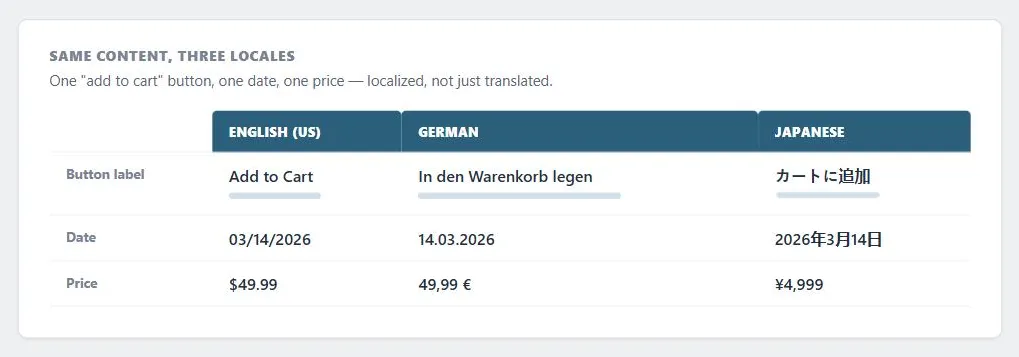 Same three facts, different renderings — the German button runs noticeably longer than English, and the Japanese one, despite carrying far fewer characters, comes out about as long since each full-width CJK glyph renders wider than a Latin letter; the date and price formats are restructured in addition to a simple translation.
Problem
A site built for one language and region has assumptions about URL structure, content storage, text length, reading direction, number/date/currency formats, and even legal obligations baked into it. Reaching international markets means re-engineering all of that, not just translating the visible copy — and getting it wrong forces retroactive engineering work far more expensive than building for it from the start.
Reaching international markets means re-engineering all of that, not just translating the visible copy — and getting it wrong forces retroactive engineering work far more expensive than building for it from the start.
Solution
Internationalization (abbreviated i18n) is the practice of designing a site so it can be adapted for different languages, regions, and cultures without re-engineering the core product. Localization (l10n) is the subsequent act of adapting a specific locale’s content and formatting.
Signal language through URL structure
Sites serving multiple locales need a URL strategy that is both machine-readable (for search engines) and human-understandable:
- Country-code top-level domains (ccTLDs) — e.g.,
example.fr,example.de— provide the strongest geo-targeting signal but require separate domain registrations and distinct infrastructure per country. - Subdirectories — e.g.,
example.com/fr/— are operationally simpler, consolidate domain authority, and are preferred for most sites. - Subdomains — e.g.,
fr.example.com— are treated by search engines similarly to separate sites; avoid unless there is a specific infrastructure reason.
Add hreflang tags to prevent duplicate-content penalties
hreflang tags tell search engines which page is the canonical version for each language/region combination, preventing duplicate-content penalties. Every localized page should include hreflang annotations for all its equivalents.
<link rel="alternate" hreflang="en" href="https://example.com/en/" />
<link rel="alternate" hreflang="fr" href="https://example.com/fr/" />
<link rel="alternate" hreflang="de" href="https://example.com/de/" />
<link rel="alternate" hreflang="x-default" href="https://example.com/" />
Set up a content management system (CMS) and translation infrastructure
The CMS must support multi-language content management — the ability to store, retrieve, and edit content independently per locale — before localization work can begin. Retrofitting a monolingual CMS is significantly more expensive than choosing one that supports i18n from the start.
Design for text expansion
Translated content is routinely 20–40% longer or shorter than the English source — German and Finnish text expands; Chinese text contracts. UI layouts that depend on fixed text widths break under translation:
- Use flexible/fluid layouts, not fixed-width text containers (see Responsive Web Design)
- Avoid truncation in buttons, navigation labels, or other key UI strings — truncation obscures meaning and the degree of truncation varies by locale
- Test with placeholder “long strings” during layout design, before translations exist
Support right-to-left (RTL) languages
Arabic, Hebrew, Persian, and Urdu are written right-to-left. RTL support is not simply mirroring text — it requires:
- Declaring
dir="rtl"on the HTML element or specific containers - Ensuring that layout (sidebars, reading order, iconography direction) mirrors logically, not only typographically
- Testing with actual RTL users — automated mirroring handles most cases but misses culturally-specific conventions
<!-- Default, left-to-right -->
<html lang="en" dir="ltr">

<!-- Arabic, right-to-left -->
<html lang="ar" dir="rtl">
Decide early whether RTL is in scope; adding it after a site is built is a significant rework, not a flag flip.
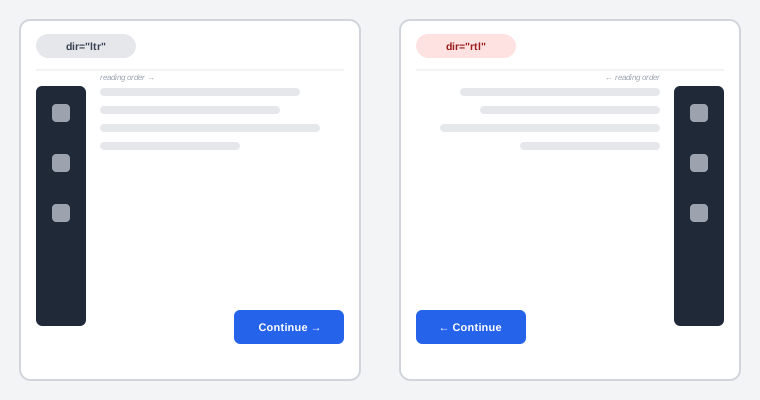 Every element that implied a direction — the sidebar, the reading order, the button and its arrow — flips as a set; translating the words alone would leave the layout pointing the wrong way.
Direction is only one axis of script variation: typeface selection and spacing conventions also vary across scripts (Latin, CJK — Chinese, Japanese, Korean — Arabic, Devanagari), and text rendering requirements differ from those of Latin-script languages.
Localize numbers, dates, and currency
Numbers, dates, times, and currency are formatted differently by locale and must be localized, not merely translated:
- Currency: symbol placement varies (€100 vs. 100 €); decimal and thousands separators vary (1,000.00 vs. 1.000,00); always show the currency code (USD, EUR, JPY) for international audiences in addition to the symbol
- Dates: MM/DD/YYYY (United States) vs. DD/MM/YYYY (most of Europe) vs. YYYY-MM-DD (ISO 8601); ambiguous formats (06/07) read as June 7 or July 6 depending on locale; use unambiguous formats or spelled-out month names for user-facing dates
- Time: 12-hour vs. 24-hour convention; time zone display and conversion
- Phone numbers: formatting conventions differ significantly by country; avoid enforcing a single input mask
- Address forms: field sets and their labels are themselves locale-specific, not just the values entered into them — a “Zip Code” field means nothing in a country that uses “Postal Code,” and a “State” field has no equivalent at all in many countries. Adapt the field set and its labels to the selected country rather than leaving an inapplicable field empty.
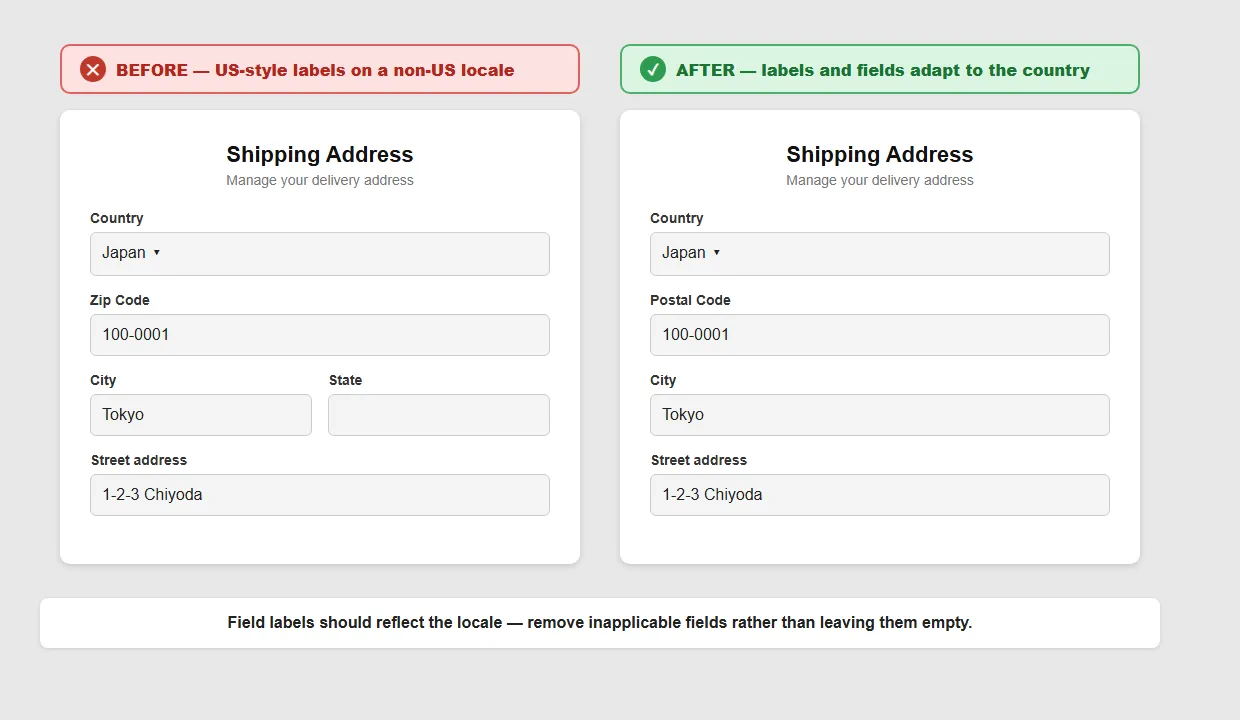 An empty field a customer can’t fill in is still a form that doesn’t fit their country — removing it is part of localizing, not an edge case to tolerate.
Plan the translation and localization process
Machine translation alone is not a substitute for a human translator: software cannot resolve context-dependent ambiguity (a word like “cook” used as a navigation label could mean the verb, a job title, or a surname, and a machine will commit to one reading regardless of which was intended). Hire translators with genuine domain and cultural familiarity with the target audience, not just language fluency — a technically fluent but culturally uninformed translation still produces embarrassing mistakes.
Machine translation alone is not a substitute for a human translator: software cannot resolve context-dependent ambiguity (a word like “cook” used as a navigation label could mean the verb, a job title, or a surname, and a machine will commit to one reading regardless of which was intended).
Choose a localization management structure deliberately: centralized management gives every product area access to shared translation services but lacks each area’s domain expertise; decentralized management taps domain expertise spread across the organization but sacrifices cross-team consistency, since teams in different locales may not know what terminology choices other teams have already made. A hybrid — central infrastructure with local review — is the common compromise.
Adapt culturally, beyond translation
Translation is necessary but not sufficient — full localization also means:
- Use familiar terminology: acronyms and institutions taken for granted domestically (e.g. a country-specific tax agency or sports league) are often unrecognized abroad; prefer terms that translate as concepts, not just as words.
- Respect color and symbol meaning: color associations are not universal — white, not black, is the color of mourning in China and Taiwan — so a color or icon chosen for its meaning in one market can carry an unintended, even offensive, connotation in another. See Color Theory for the broader case against treating any color scheme as a universal design constant.
- Plan around holidays, customs, and support coverage: staffing for customer-facing functions (support, moderation) needs to account for the target locale’s own holiday calendar, not just the home market’s.
- Tailor services, not just words: local food preferences, shopping habits, and other behavioral differences may call for changes to the product or service itself, discoverable through the same on-the-ground research techniques used for any other audience.
color associations are not universal — white, not black, is the color of mourning in China and Taiwan — so a color or icon chosen for its meaning in one market can carry an unintended, even offensive, connotation in another
Account for legal and jurisdictional differences
Operating across borders can trigger obligations well beyond translation: import/export and customs rules affecting what can be sold or shipped where, foreign sales-tax regimes, and content restrictions that vary by country (some jurisdictions ban specific categories of content outright, independent of what’s legal in the site’s home market). Data-protection law is frequently stricter abroad than at home — the EU, for instance, historically gave individuals broader rights to access and manage data held about them than U.S. law required at the time — so Fair Information Practices and a site’s Privacy Policy may need locale-specific variants rather than one global version.
Related Concepts
Patterns
- Clear Typography
- Responsive Web Design
- Action Buttons
- Customer Sessions
- Privacy Policy
- Search Engine Optimization
Principles
Processes
Standards
Further reading
ReForm: Free Chapters and Tips (reform.user-interface.io — ungated PDF, no stated open license) illustrates locale-specific form field adaptation: the worked example shows a Russian address form that replaces “Zip Code” with “Postal Code” and removes the “State” field entirely, since Russian postal addresses use neither concept.
Google’s Material Design 3 buttons component guidelines (m3.material.io/components/buttons — no stated content license) give a concrete instance of “iconography direction mirrors logically” from the RTL section above: a button’s icon sits on the leading edge before its label, which is the left side for left-to-right languages and the right side for right-to-left ones — see Action Buttons for the rest of that component’s guidance.
Sources
The Design of Sites: Pattern Group D — Writing and Managing Content (Pattern D10) is the source for the translator/localization-management practices, the cultural-adaptation-beyond-translation guidance, and the cross-border legal and jurisdictional considerations.