
- Plan
- Explore
- Concept
- Evaluate
- Launch
Personas and Scenarios
Overview
How do you try out a design idea against real customer needs before any software actually exists?
Tools built on top of Task Analysis for trying out design ideas before any software exists, often seeded by card sorting and Affinity Diagramming: scenarios, personas, and storyboards.
Scenario
A context-rich story focused on what a customer will do, not how (close to a software-engineering use case). Example, for a hypothetical gift-shopping site: Victoria is a bright, young college student looking for a gift for her younger sister, who is turning 16 in two weeks… She’s heard some of her friends talk about ebirthdayz.com, so she decides to check it out… Victoria finds the recommendations screen and views gifts based on her sister’s age and general interests, as well as her own limited finances… Total time spent: 20 minutes.
Note what the scenario deliberately leaves out: it never says where the recommendation feature lives on the page or how recommendations are computed — at this stage the point is to test whether the idea is compelling, not to lock in an interface.
A context-rich story focused on what a customer will do, not how (close to a software-engineering use case).
Persona
A detailed, recurring fictional customer (name, background, what they do, where they live) used across multiple scenarios so design questions can be checked against a consistent, specific person rather than an abstract “user.” E.g., “Would Victoria use a feature for sending business gifts to colleagues? No — she’s a college student, that’s irrelevant to her.” Reusing the same personas throughout a project lets the team sanity-check whether decisions still make sense as the design evolves. The book also uses the lighter-weight term profile for a shorter, less-detailed customer description assembled directly from research findings — useful early in Discovery, before a full persona has been fleshed out.
A detailed, recurring fictional customer (name, background, what they do, where they live) used across multiple scenarios so design questions can be checked against a consistent, specific person rather than an abstract “user.”
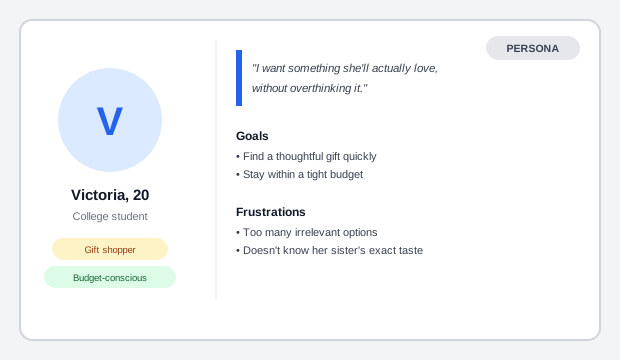 Specific enough to answer a question like “would Victoria buy this?” with a concrete yes or no — a vague “typical user” can’t be checked against a quote, a budget, or a named frustration.
Storyboard
A rough, sketched sequence of pages showing how a persona would carry out one task, paired with the scenario it dramatizes — see Storyboarding for the technique in full.
Choosing patterns and communicating intent
Scenarios and personas also point toward which design patterns are likely relevant before any pattern is chosen: a gift-shopping scenario like Victoria’s implies looking at personalization and gift-giving patterns in addition to the basic e-commerce patterns every shopping site needs. They’re also useful for communicating intent to clients and stakeholders who haven’t been in the research itself — the customer analysis document in Web Site Development Process‘s Discovery phase is typically built around exactly this kind of persona work.
Related Concepts
Processes
- Task Analysis
- Know Your Customers
- Card Sorting
- Affinity Diagramming
- Web Site Development Process
- Storyboarding
- Journey Mapping
- Service Design
Further reading
Alan Cooper et al.’s About Face: The Essentials of Interaction Design (4th edition, amazon.com/dp/1118766571 — commercially published, no stated open license) is the book most credited with popularizing personas in software design, developing goal-directed persona construction and their use throughout a design process in far more depth than this page’s own scenario/persona/storyboard trio.
Sources
The Design of Sites: Ch. 3 — Knowing Your Customers: Principles and Techniques is this page’s primary source — Chapter 3’s scenario/persona/storyboard trio, including the worked Victoria/ebirthdayz.com scenario reused as this page’s own example. The persona card above is a wiki-original visualization of that same Victoria, not a reproduction of anything in the source itself (the book doesn’t include a persona-card image).
The Design of Sites: Glossary supplies the lighter-weight “profile” term as a less-detailed alternative to a full persona, useful early in Discovery before a persona has been fleshed out.