
Mental Models
Overview
A mental model is a person’s internal representation of how something works — not the actual mechanism, but the simplified, often incomplete picture a person carries in their head and uses to predict what will happen next. Psychologist Kenneth Craik coined the term in his 1943 book The Nature of Explanation, proposing that the mind builds “small-scale models” of reality to anticipate events rather than reasoning from first principles every time.
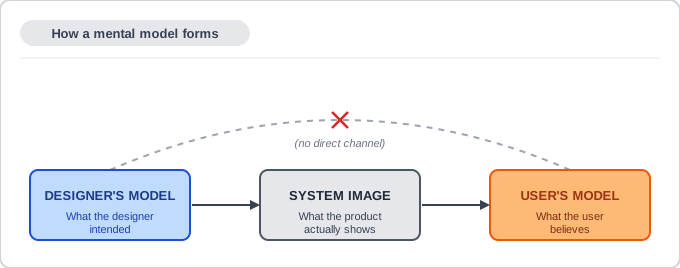 The designer can’t reach the user directly — only through what the system actually shows.
A mental model is a person’s internal representation of how something works — not the actual mechanism, but the simplified, often incomplete picture a person carries in their head and uses to predict what will happen next.
How a mental model forms
Three distinct models are in play whenever one forms: the designer’s own model of how the system should work, the system image — what the product actually shows through its labels, layout, and behavior — and the user’s model, assembled entirely from that system image rather than through any direct channel to the designer’s intentions. If the system image doesn’t communicate the designer’s model clearly, the user’s model diverges from it, and no amount of correctness in the designer’s own thinking closes that gap after the fact — the system image is the only thing a designer actually controls.
Design implications
Every user of an interface already has a mental model of it before they’ve touched it — assembled from prior software they’ve used, real-world analogies (a “folder,” a “shopping cart,” a “trash can”), and whatever the interface’s own labels and behavior suggest on first glance. Usability problems often come down to a mismatch between this model and how the system actually behaves: the user predicts one outcome, the system does another, and the resulting surprise is where confusion and errors come from — e.g. a navigation menu whose visual grouping doesn’t match the site’s actual information architecture, which leads users to predict wrong locations for things.
Every user of an interface already has a mental model of it before they’ve touched it — assembled from prior software they’ve used, real-world analogies (a “folder,” a “shopping cart,” a “trash can”), and whatever the interface’s own labels and behavior suggest on first glance.
Because a user’s mental model is built from signals the interface gives off — its labels, icons, layout, and response to actions — designers cannot install a mental model directly, only shape it indirectly by making the system behave consistently with the model they intend users to form. This is the same territory Interface Design Principles‘s consistency principle covers from a different angle, and it’s the deeper reason Nielsen’s “match between system and the real world” heuristic works: borrowing a model the user already has (from the physical world or from other software) is cheaper than teaching a new one from scratch.
Because a user’s mental model is built from signals the interface gives off — its labels, icons, layout, and response to actions — designers cannot install a mental model directly, only shape it indirectly by making the system behave consistently with the model they intend users to form.
Connections to other principles
- Affordance — affordances and signifiers are the raw material a user draws on to build a mental model in the first place; a misleading signifier (e.g. a flat, button-shaped area of text that isn’t clickable) seeds an incorrect model before any interaction happens.
- Gulfs of Execution and Evaluation — Norman‘s gulf of execution and gulf of evaluation are, respectively, the gap between a user’s mental model of what actions are possible and what’s actually possible, and the gap between what the system just did and what the user’s model tells them to expect.
- Cognitive Load — building a new mental model on first use of an unfamiliar interface is germane load; once formed, a correct model lets later interactions run on recognition rather than deliberate reasoning, which is why consistency across a product line amortizes that cost instead of re-charging it on every screen.
- Gestalt Psychology — gestalt grouping principles explain how a person perceptually organizes one ambiguous visual stimulus based on what they’ve seen before; a mental model is the same categorization mechanism operating at the scale of a whole interface rather than a single stimulus.
Related Concepts
Patterns
Principles
- Affordance
- Gulfs of Execution and Evaluation
- Cognitive Load
- Interface Design Principles
- Interface Metaphor
- Gestalt Psychology
- Information Architecture
Processes
Further reading
Jakob Nielsen’s “Mental Models and User Experience Design” (NN/g, 2010 — commercially published, no stated open license) develops the same designer/user mismatch this page’s Design implications section names, with worked examples this page doesn’t have: an online-shopping site auto-adding shipping insurance to the cart total, violating the “I control what’s in my cart” model users already bring; and mobile apps whose early back-button behavior sent users up an app’s internal hierarchy rather than to the previous screen, contradicting the model the web’s own back button had already trained.
Indi Young’s Mental Models: Aligning Design Strategy with Human Behavior (Rosenfeld Media, 2008, ISBN 978-1933820595 — commercially published, no stated open license) develops mental models as a dedicated research method rather than a cognitive-science concept applied after the fact: interview-driven mental-model diagrams that group a person’s own behaviors, reasoning, and emotional reactions into “towers,” used to check a product’s structure against how people already think about the problem it solves, rather than against the org chart or feature list that actually produced it.
Sources
Mental Model (Wikipedia) (Wikipedia) is this page’s sole source — the mental-model definition itself and Kenneth Craik’s 1943 coinage.