
Community Conference
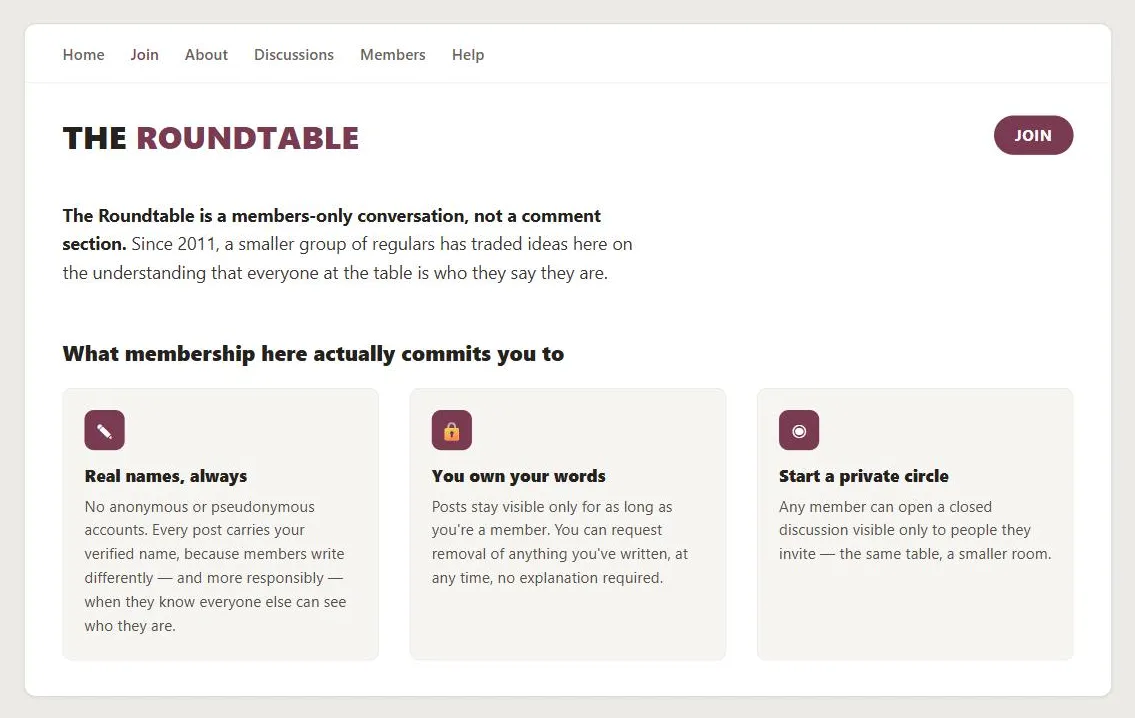 Stating these three policies up front — identity, data ownership, and access control — is what turns “here’s a message board” into a stated commitment members can hold the site to.
Background
A community conference is frequently layered onto another site genre rather than standing alone. A grassroots information site often arrives here from the opposite direction: static, maintainer-published content that opens up to reader participation and becomes a community conference as well as an information resource. At scale, a recommendation community can let members rate each other’s contributions, giving newcomers a way to judge who’s worth listening to.
Problem
Setting up a message board is mechanically easy, but a bare board doesn’t by itself produce a community whose members trust each other enough to speak honestly — that takes deliberate policy decisions a board doesn’t force anyone to make.
Setting up a message board is mechanically easy, but a bare board doesn’t by itself produce a community whose members trust each other enough to speak honestly — that takes deliberate policy decisions a board doesn’t force anyone to make.
Solution
A community conference is a site genre built around letting people carry on trustworthy, ongoing conversations with one another — as distinct from Message Boards, which is the mechanical posting/reading/searching pattern a community conference is built out of.
Set a usage policy
Every community needs its own explicit standards (what’s on-topic, what gets a post removed, what happens to repeat violators) and a stated data-handling policy, communicated through a Privacy Policy — deciding these after launch, once norms have already formed informally, is much harder than deciding them up front.
Choose synchronous or asynchronous communication
Synchronous forums (chat, video, shared drawing) enable spontaneous, fast-moving discussion but punish slow connections and make it hard to follow who said what; asynchronous forums (Message Boards, blogs, community-authored pages) support more considered responses at the cost of slower consensus. The two aren’t strictly separate — an archived synchronous chat becomes an asynchronous resource once it’s saved. Most communities end up supporting both, matched to the kind of exchange each topic needs.
Set a moderation level
Ranges from fully moderated (every post reviewed before it appears — appropriate where getting it wrong has real stakes, like a support group for a serious illness) to fully unmoderated (anything goes, norms enforced only by the community itself) with many hybrids between — e.g., moderating only a poster’s first few messages, or spot-checking rather than reviewing every post. There’s no universally correct setting; it depends on what kind of discussion the community is meant to have.
Set an anonymity level
A spectrum from full anonymity (protects vulnerable posters — e.g. abuse victims, employees discussing their employer — but weakens accountability and invites abuse) through pseudonymity (a consistent assumed identity known to the community but not necessarily verified). At the far end sits fully verified real names (site operators know who everyone is, which measurably increases responsible posting). The right level depends on context: an anonymous cancer-support board and a K-12 class discussion warrant very different defaults, and what’s disclosed to the community can differ from what’s disclosed only to the site operator.
A spectrum from full anonymity (protects vulnerable posters — e.g. abuse victims, employees discussing their employer — but weakens accountability and invites abuse) through pseudonymity (a consistent assumed identity known to the community but not necessarily verified).
Set an archiving policy
Three separate questions: will messages be stored at all, for how long, and who can see or delete old ones? Archives have real value (searchable institutional memory, a record of past reasoning, research value) but also real cost (old posts written in haste can resurface years later out of context, and archives are discoverable in legal disputes). There’s no single right retention period — it’s a case-by-case call that belongs in the site’s Privacy Policy.
Tend the conversation
Some ongoing conversation requires active moderator attention — “providing the space but not tending the conversation is like expecting your front yard will turn itself into a garden” (Teresa Nielsen-Hayden). Practical moderation guidance drawn from her widely-cited list: over-specific rules invite people who like gaming the system; message persistence (letting good posts stay visible) rewards good contributors; remove genuinely offensive posts quickly rather than advising people to “just ignore” them; and two disruptive posters feeding off each other need to be removed together, immediately, since they escalate each other. Disemvowelling — stripping the vowels from a post rather than deleting it outright — is one concrete technique for defusing a bad post without erasing that it happened.
Trust, sociability, and growth
Online communities lose some in-person social cues but gain geographic reach and asynchronous participation — trade-offs a moderator actively manages by keeping discussions on-topic and modeling the norms members are meant to follow. Growth is subject to a network effect: communities need to reach a critical mass of active members before they become self-sustaining, and reaching that threshold is worth disproportionate early effort (seeding discussions, personally inviting first members) because growth becomes much easier once newcomers can see an already-active community. This also explains why community conferences are stickier than e-commerce: a customer can switch to a competing store in one click, but can’t as easily take their friends and ongoing conversations with them.
Growth is subject to a network effect: communities need to reach a critical mass of active members before they become self-sustaining, and reaching that threshold is worth disproportionate early effort (seeding discussions, personally inviting first members) because growth becomes much easier once newcomers can see an already-active community.
Related Concepts
Patterns
- Message Boards
- Recommendation Community
- Privacy Policy
- Sign-In and Account Creation
- Blogs
- Nonprofits as Networks of Help
- Educational Forums
- Grassroots Information Sites
Standards
Sources
The Design of Sites: Pattern Group A — Site Genres (Pattern A3, Community Conference) is this page’s sole source — its usage-policy, moderation, anonymity, archiving, and community-growth guidance, including the Teresa Nielsen-Hayden moderation quote, comes directly from it.