
Easy Returns
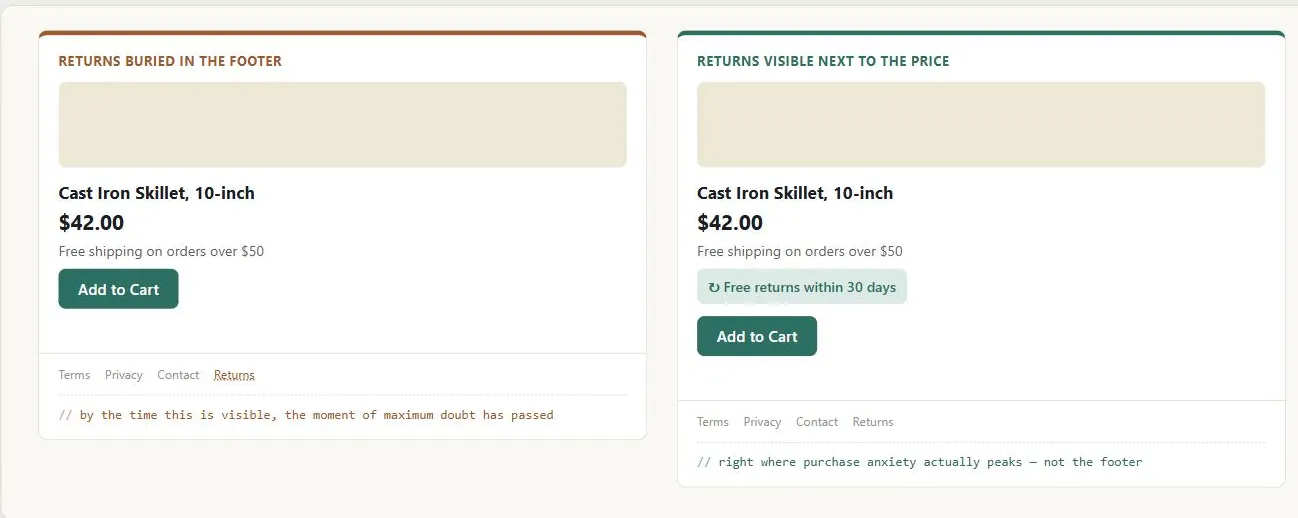 The footer link was never actually hidden — it just arrives long after the doubt it was supposed to answer.
Background
Returns and purchases form a loop: a generous, visible return policy increases purchase confidence, which increases orders and repeat purchases from customers who trust the return process. Treating the return policy as a cost center to minimize rather than a trust signal to invest in typically reduces both conversion and lifetime customer value. A 2003 eHoliday Mood Study (Shop.org/BizRate) found roughly 45% of holiday shoppers researched gift purchases in physical stores or catalogs before buying online, and roughly 50% researched online before buying in a store or catalog — shoppers move freely between channels, so a return process has to reassure customers who may not have handled the product before buying it online.
Returns and purchases form a loop: a generous, visible return policy increases purchase confidence, which increases orders and repeat purchases from customers who trust the return process.
Problem
Customers who encounter a vague, hard-to-find, or punitive return policy at purchase time are more likely to leave without buying — return anxiety operates before the purchase decision, not only after a return is actually needed.
return anxiety operates before the purchase decision, not only after a return is actually needed.
Solution
A clear, accessible return process — visible everywhere purchase anxiety peaks, backed by a self-service return funnel — turns the return policy into a trust signal.
Make the policy visible
The return policy should be linked or summarized on:
- Every product details page, near the price and shipping information — this is where purchase anxiety peaks
- Every checkout page, especially the order summary step where the customer reviews before committing
- Category and search results pages, so browsing customers can see the policy without clicking into a product
- The homepage, as a persistent trust signal
A return policy buried in a footer link or a separate frequently asked questions (FAQ) page works only for customers who know to look — it misses the moment of maximum doubt, which is the product page.
Build a self-service return process
A self-service return funnel removes the friction that makes customers dread returns and keeps them from purchasing in the first place. The flow:
- Find the order — customer locates the purchase in their order history or via an order number
- Select items to return — choose which items from that order to return, with quantities if applicable
- Select reason — a short pick list of return reasons (wrong size, not as described, changed mind, damaged/defective); this data is valuable for inventory and product quality feedback
- Print return label — generate a prepaid, trackable shipping label the customer prints and attaches to the package
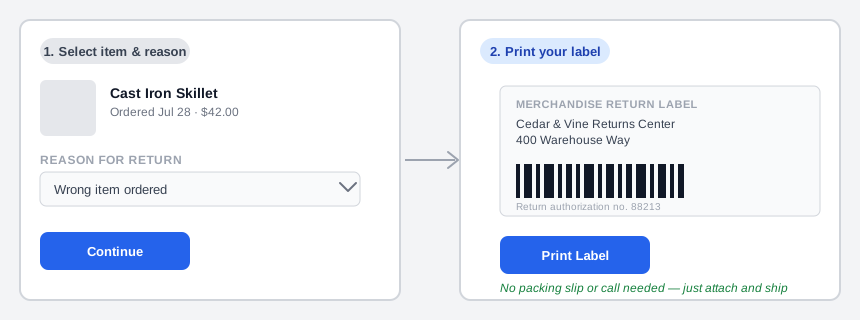 Two screens, not four — selecting items and reason share one step, and the label prints immediately after.
Use trackable labels and credit refunds quickly
A trackable return label lets the customer verify that the return was received, removing the anxiety of uncertainty (“did they get it?”). It also creates a processing record on the retailer’s side. The key trust element is credit speed: the faster a refund or exchange is processed after the return is received, the more likely the customer is to purchase again. Delay at the credit stage undercuts the goodwill of an otherwise smooth return experience.
The key trust element is credit speed: the faster a refund or exchange is processed after the return is received, the more likely the customer is to purchase again.
Related Concepts
Patterns
- Quick-Flow Checkout
- Process Funnel
- Order Tracking and History
- Action Buttons
- Frequently Asked Questions
Principles
Further reading
Baymard Institute’s “The ‘Order Returns’ Experience is Critical for Customer Retention” (commercially published, no stated open license) backs the trust-signal argument above with a current benchmark: 54% of e-commerce sites have substantial returns-flow usability issues, and 15% of customers have abandoned a purchase over an unsatisfactory return policy.
Sources
The Design of Sites: Pattern Group F — Basic E-Commerce is this page’s F9 Easy Returns pattern source — the case for placing return-policy links on every product and checkout page, and the four-step self-service return funnel (find the order, select items, select reason, print label).
The Design of Sites: Pattern Group A — Site Genres supplies the 2003 eHoliday Mood Study statistic in Background — the cross-channel research finding (roughly 45% researching in-store then buying online, 50% the reverse) that motivates treating returns as pre-purchase risk reduction rather than only a post-purchase process.