
Hick’s Law
Overview
A foundational human-computer interaction (HCI) law from psychologist William Edmund Hick’s 1952 study (“On the rate of gain of information”), with related work by Ray Hyman in 1953 — sometimes called the Hick–Hyman law. It describes how decision time grows as the number of choices grows: more options take longer to choose among, but not in direct proportion. Doubling the number of choices does not double decision time; the relationship is logarithmic, so each additional option adds progressively less delay than the one before it.
Doubling the number of choices does not double decision time; the relationship is logarithmic, so each additional option adds progressively less delay than the one before it.
The relationship
For equally probable choices, reaction time (T) relates to the number of choices (n) as T = b·log₂(n+1), where b is an empirically fitted constant. The log₂ base reflects a binary-search-like process: people narrow down a large option set efficiently, the same way a search algorithm halves a sorted list at each step — if the set is organized in a way that supports that narrowing. Unequal-probability choices (some options picked far more often than others) need an adjusted, information-theoretic version of the formula.
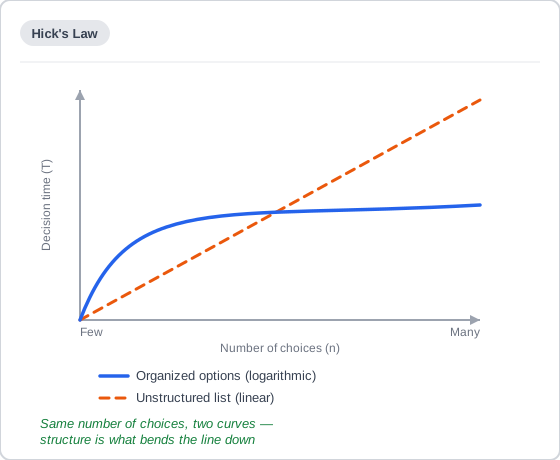 Same option count, two very different decision-time outcomes — the gap only shows up once the count gets large.
Design implications
- Structure beats raw count. A long alphabetized or categorized menu lets people subdivide it logarithmically (the same way they’d find a name in a phone book). An unstructured list of the same length forces linear, one-by-one scanning, where the logarithmic benefit disappears entirely — “Hick’s law does not apply” to an unordered list, in the article’s own words. The practical lesson is about organization, not just trimming options.
- Progressive Disclosure — showing fewer choices at once, with a path to reveal more — reduces the immediate decision load even when the total option count doesn’t shrink. Homepage Portal‘s 95%/5% rule (dedicating most above-the-fold space to the dominant audience’s needs and pushing rarer needs to a subsidiary page) is a concrete instance of this, arrived at independently of this law in the book it comes from.
- Search vs. browsing trade off differently against this law: a well-organized navigation hierarchy benefits from the logarithmic curve, while an unstructured set of links does not — which is itself an argument for the kind of deliberate grouping Grid Layout already recommends, even though that page doesn’t name this law. The underlying mechanism connects to Cognitive Load: organized choices can be processed as structured chunks that fit within working-memory limits, while an unstructured list of equivalent length cannot.
An unstructured list of the same length forces linear, one-by-one scanning, where the logarithmic benefit disappears entirely — “Hick’s law does not apply” to an unordered list, in the article’s own words.
Limitations
The law doesn’t hold universally: verbal responses to highly familiar stimuli show little reaction-time increase regardless of choice count, and reflexive eye-movement (saccade) responses can show no relationship to choice count or even the opposite effect. Predictability within a sequence of repeated choices also doesn’t follow the same curve. A frequently cited extension (E. Roth, 1964) found that the rate of information processing implied by an individual’s Hick’s-Law curve correlates with IQ, framing the law as a rough measure of cognitive processing capacity rather than only a UI design rule of thumb.
Relationship to Fitts’s Law
Fitts’s Law and Hick’s Law are often discussed together because both describe logarithmic relationships in human-computer interaction, but they govern different things. Fitts’s Law is about physically reaching a target once you’ve picked it, while Hick’s Law is about deciding which one to pick in the first place — the former measures movement time as a function of distance and size, the latter measures decision time as a function of how many options there are and how they’re organized.
Fitts’s Law is about physically reaching a target once you’ve picked it, while Hick’s Law is about deciding which one to pick in the first place.
Related Concepts
Patterns
Principles
Processes
Further reading
Victor Ponamariov’s 50 Tips to Improve User Interface (goodreads.com/book/show/58085971-50-tips-to-improve-user-interface — self-published ebook, no stated license) applies this law to option selectors: for five to seven or fewer choices, replace dropdowns with immediately-visible options (radio buttons, card selectors, tag toggles) to reduce decision cost — see Form Design for more.
W.E. Hick’s “On the Rate of Gain of Information” (Quarterly Journal of Experimental Psychology, 4(1), 11–26, 1952) and Ray Hyman’s “Stimulus Information as a Determinant of Reaction Time” (Journal of Experimental Psychology, 45(3), 188–196, 1953) — both commercially published, no stated open license — are the two original papers named in this page’s own Overview but never directly cited until now: Hick’s finding that choice-reaction time grows with the logarithm of the number of alternatives at a roughly constant information-processing rate near five bits per second, and Hyman’s follow-up isolating stimulus information itself, rather than raw alternative count, as the variable actually driving that relationship.
Sources
Hick's Law (Wikipedia) (CC BY-SA) is this page’s source for the T = b·log₂(n+1) formula, the structured-vs-unstructured-list distinction (“Hick’s law does not apply” to an unordered list), and the Roth 1964 IQ-correlation finding above.