
Seven Stages of Action
Overview
Donald Norman‘s model of how a person actually carries out and checks any action, split into four execution stages and three evaluation stages.
The seven stages
Execution (doing something to the world):
- Forming the goal — the state to be achieved (e.g., “I need more light to keep reading”).
- Forming the intention to act on that goal.
- Specifying an action — translating the intention into a concrete sequence (reach toward the lamp, extend a finger toward the switch).
- Executing the action — actually performing it.
Evaluation (checking whether it worked):
- Perceiving the state of the world after acting.
- Interpreting that perception.
- Evaluating the interpretation against the original intention and goal.
Norman built this model after watching, at an Italian conference, several people in succession fail to thread a film projector none of them had used before — confusion compounding as more people tried to help, until a technician fixed it in seconds. The puzzle wasn’t that the task was hard in the abstract; it was that nothing about the projector communicated what to do, at any of these seven points.
The puzzle wasn’t that the task was hard in the abstract; it was that nothing about the projector communicated what to do, at any of these seven points.
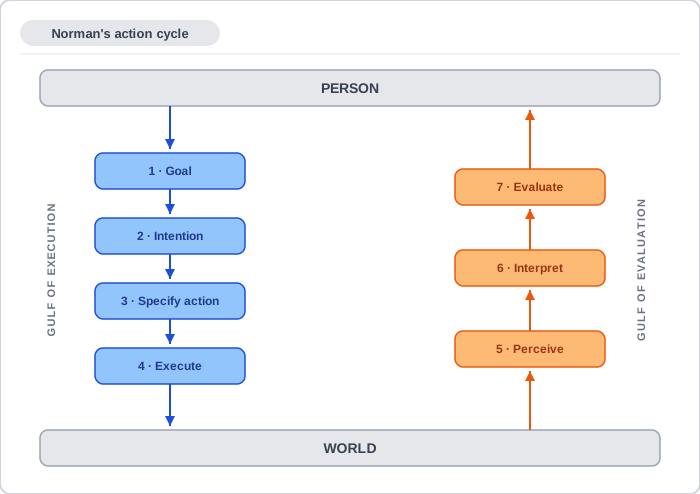 Left: does the interface make the actions available? Right: does it make what happened easy to interpret?
Design implications
The seven stages work as a diagnostic checklist for design review: walk through a proposed design one stage at a time and ask whether that stage is clear, learnable, and confirmable.
The seven stages work as a diagnostic checklist for design review: walk through a proposed design one stage at a time and ask whether that stage is clear, learnable, and confirmable.
Two of Interface Design Principles‘s own seven principles are really this checklist’s evaluation half applied directly — offering informative feedback and helping customers recover from errors are both about keeping the perceive/interpret/evaluate stages legible. Splitting the cycle in half this way — four execution stages, three evaluation stages — is also where Norman names two general failure modes, along with the four design principles that address them; see Gulfs of Execution and Evaluation. The checklist is built around a single action, though — Journey Mapping is what extends the same per-action framing across a whole multi-step journey, showing which specific phase along the way is producing a gulf rather than checking one action in isolation.
Related Concepts
Principles
Processes
Further reading
Don Norman’s The Design of Everyday Things (Revised and Expanded Edition, amazon.com/dp/0465050654 — commercially published, no stated open license) is the full-length book this model comes from, developing the seven stages with many more product examples than the Wikipedia summary above covers.
Sources
The Design of Everyday Things (Wikipedia) is this page’s sole source — the seven-stages-of-action model itself and the Italian-conference film-projector origin story.