
Recommendation Community
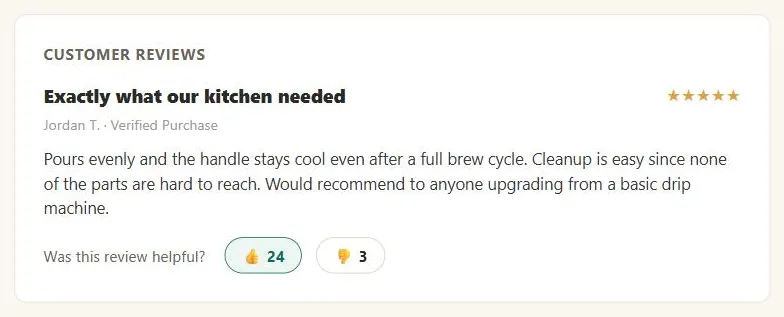 The helpful-vote count is the community grading its own reviews, so the site never has to judge quality itself.
Background
A recommendation community is structurally a message board scoped to a single product: the same anonymity/moderation decisions, findability concerns, and administrative tooling apply, narrowed to one topic per board. The same openness that makes it valuable (real, unfiltered customer voices) is what creates its moderation burden. Tightening review rules to reduce risk also reduces how authentic reviews feel, so the two pull against each other and the right balance is a legal and editorial judgment call, not a fixed rule.
Tightening review rules to reduce risk also reduces how authentic reviews feel, so the two pull against each other and the right balance is a legal and editorial judgment call, not a fixed rule.
Problem
Customer reviews are valuable enough that people will leave a site to find them elsewhere if they’re missing — a 2000 Pew Internet & American Life Project survey found 73% of people research a product or service before buying it. But running a review system well means managing genuine abuse risk (obscenity, libel, copyrighted material, fake or commercially-motivated reviews) without that moderation burden becoming unmanageable.
Customer reviews are valuable enough that people will leave a site to find them elsewhere if they’re missing — a 2000 Pew Internet & American Life Project survey found 73% of people research a product or service before buying it.
Solution
Scaffold the writing process as a two-step process funnel
First, a title, free-text body, and numerical rating, with concrete writing guidelines (what to cover, what to avoid — e.g. don’t spoil endings, don’t attack the author personally); second, a review of what was written, exactly as it will appear, before it posts. See Process Funnel.
Publish use policies and filter automatically
Filter for profanity and outbound links before anything posts, and keep a human editor in the loop afterward — exhaustive pre-screening isn’t realistic at volume, so spot-checking plus a “report this” path covers what filters miss. These policies sit alongside a site’s broader fair-information and privacy practices (e.g. handling reviews from minors), which is worth involving legal counsel on given the liability exposure.
Add meta-ratings
A “was this review helpful?” vote or a simple +1/0/−1 reputation score lets the community itself separate trustworthy reviews and reviewers from noise, without the site having to adjudicate quality directly. Implement the vote itself with an action button.
A “was this review helpful?” vote or a simple +1/0/−1 reputation score lets the community itself separate trustworthy reviews and reviewers from noise, without the site having to adjudicate quality directly.
Prime the pump
A new recommendation community needs enough reviews to look credible before it can grow further — surface reviews prominently next to the product they’re about, make adding one easy, and consider a direct incentive (a contest, a small reward) for a site’s very first reviewers.
Related Concepts
Patterns
- Featured Products
- Cross-Selling and Up-Selling
- Personalized Recommendations
- Process Funnel
- Action Buttons
- Message Boards
- Community Conference
Principles
Sources
The Design of Sites: Pattern Group G — Advanced E-Commerce (G4 Recommendation Community) is this page’s sole source — the two-step write/preview review funnel, use-policy filtering, and the meta-rating mechanism (Amazon’s “helpful?” votes, eBay’s buyer/seller feedback score) cited under Add meta-ratings all come directly from G4.