
- Plan
- Explore
- Concept
- Evaluate
- Launch
Service Design
Overview
How do you improve a service experience that’s shaped by people, infrastructure, and process, not just an interface?
The activity of planning and arranging the people, infrastructure, communication, and material components of a service, to improve both its quality and the interaction between the people providing it and the people using it. Service design draws on ethnography, information science, management science, and interaction design, and produces service concepts that define the intended customer experience alongside the physical, human, and technological resources needed to actually deliver it.
The activity of planning and arranging the people, infrastructure, communication, and material components of a service, to improve both its quality and the interaction between the people providing it and the people using it.
How it differs from product or interface design
Service design differs from product or interface design in one important way: a designer can specify a product’s behavior directly, but can’t fully prescribe the outcome of a person-to-person service interaction, or the emotional value a user takes from it. Service design instead shapes the conditions — the sequence of steps, the tools staff have on hand, the information available at each point — under which a good interaction becomes likely, rather than authoring the interaction itself.
Service design instead shapes the conditions — the sequence of steps, the tools staff have on hand, the information available at each point — under which a good interaction becomes likely, rather than authoring the interaction itself.
Five principles
1. User-centered
Broadened to “human-centered” in a 2018 revision. A service should be experienced through the customer’s eyes, but “user” here means everyone touched by the service, including the employees delivering it, not customers alone.
2. Co-creative
Every stakeholder, users included, contributes resources toward the value a service produces; this combines two related ideas, that service design is collaborative (many people shape it) and iterative (see Iterative Design).
3. Sequencing
A service is visualized as a sequence of interrelated actions, which is what makes it possible to map a timeline and plan development against it.
4. Evidencing
Intangible services are made visible through physical artifacts — a receipt, a confirmation screen, a uniform — so a user can perceive that something is actually happening at each step.
5. Holistic
The entire environment of a service should be considered, across every touchpoint and channel a user might encounter it through, not just the one channel currently being designed.
Characteristics of a well-designed service, in practice
Beyond the five academic principles above, government service-design practice names a more concrete set of characteristics a good service actually has:
- Internal structure stays hidden. If completing one task means pulling data from two separate back-end systems, a user shouldn’t need to know that — they need one quick way of accessing what they’re after, not an explanation of the plumbing behind it.
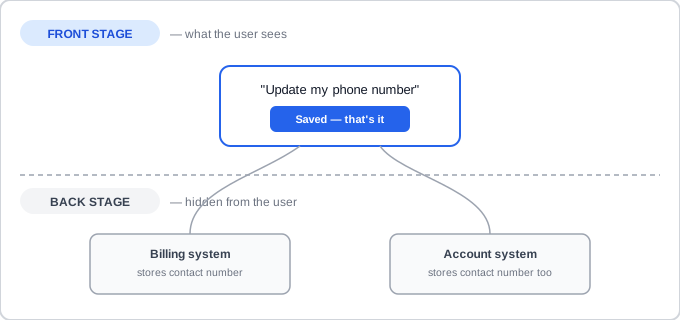 One update, one confirmation — the user never has to know two separate systems just synced to make that happen.
- No dead ends. Every user reaches a clear outcome, even one who turns out not to be eligible; nobody is left stranded mid-service without knowing what to do next.
- Fewer steps also means fewer mistakes. Reducing what a user has to enter isn’t just about saving effort — a postcode lookup instead of manual address entry, or reviewing previously-given information instead of re-entering it, both cut the opportunities for error at the same time they cut steps.
- Deliberately slow down risky moments. Where a step carries real consequences if a user acts too fast, a good service adds friction on purpose — a warning screen before a significant change to personal data, for instance — rather than optimizing every step for speed uniformly.
- Consistency holds in real time, not just in style. Beyond shared visual language, a service should reflect a user’s own update immediately across every channel — if someone changes their phone number online, a phone agent should see that change right away, not a stale record from before it.
- Decisions are explainable, including algorithmic ones. Where a service uses an algorithm to make or suggest a decision, that involvement should be clear to the user, and there should be a way to challenge or request review of the outcome — an operational instance of the same transparency explainable AI argues for more generally.
- Human help stays reachable. Self-service can’t cover every case — an unpredictable technical failure, or a user who genuinely can’t produce a piece of required evidence — so a straightforward path to a human being has to exist for when it doesn’t.
Methodology
Three broad categories of tool, corresponding to three stages of the work:
- Analytical tools — ethnography, anthropology, and video-ethnography, used to identify who the actual actors in a service are and understand the context they operate in; the same observational grounding Customer Research Methods describes.
- Design tools — service blueprints, scenarios, and use cases, adapted from software engineering to document a service’s interactions and functional requirements. See Journey Mapping for how a service blueprint (the operational, backstage view of a journey) compares to a journey map (the user-facing view of the same journey).
- Collaborative methods — co-design and storytelling techniques that put users directly into the process of producing a service’s narrative, so scenarios are grounded in real customer experience rather than designer assumption.
Touchpoints
A touchpoint is any point of contact where a user actually interacts with a service — in person, by phone, on the web, in an app, or by mail. The holistic principle above exists specifically because a service’s touchpoints span more than one channel: a design that only accounts for the touchpoints inside one channel will miss the moments where a user crosses from one to another. Servicescape — a related idea from Booms and Bitner — is the physical-environment-specific case of this: how the space itself (layout, signage, lighting, wayfinding) shapes a service encounter, the way a well- or poorly-designed waiting room shapes how a visit feels before the actual service interaction even starts.
a design that only accounts for the touchpoints inside one channel will miss the moments where a user crosses from one to another.
Related Concepts
Processes
- Journey Mapping
- Customer Research Methods
- Customer-Centered Design
- Personas and Scenarios
- Rapid Prototyping
- Iterative Design
- Participatory Design
Further reading
Marc Stickdorn and Jakob Schneider’s This Is Service Design Thinking: Basics, Tools, Cases (Wiley, 2012, ISBN 978-1118156308 — commercially published, no stated open license) is the field’s widely-used practitioner handbook, developing an iterative service-design process and 25 named tools — including journey mapping and service blueprinting, each covered here only at a single-paragraph depth — alongside five international case studies.
Sources
Service Design (Wikipedia) (CC BY-SA 4.0) is this page’s original source — the definition, the five design principles (user-centered, co-creative, sequencing, evidencing, holistic), the three-part methodology (analytical, design, and collaborative tools), and the touchpoint/servicescape material in Touchpoints.
Designing Good Government Services: An Introduction (GOV.UK Service Manual) (OGL v3.0) is the source for the practical characteristics above — hidden internal structure, no dead ends, fewer-steps-means-fewer-mistakes, deliberate friction before risky steps, real-time cross-channel consistency, algorithmic-decision transparency, and reachable human help.