
Educational Forums
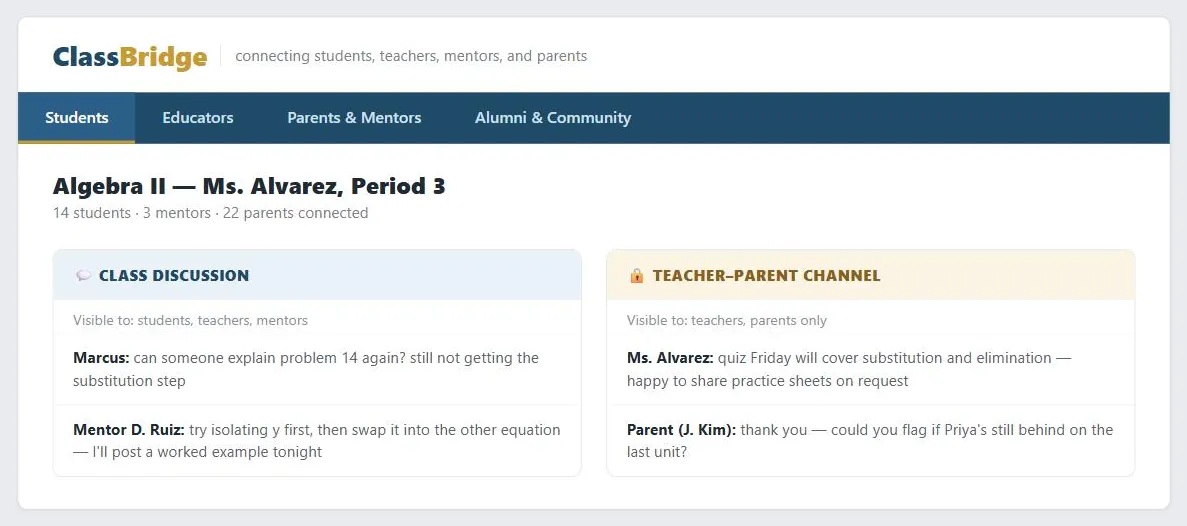 Same class, two channels: role-differentiated access isn’t a single message board with a filter — it’s two genuinely separate spaces, each seeing a conversation the other doesn’t.
Problem
The people around a student’s development — students, parents, teachers, mentors, and alumni — otherwise interact only through in-person meetings and phone calls constrained by geography and scheduling, and a forum focused only on administrative efficiency (schedules, forms) misses the actual educational value of connecting them. Optimizing for administration can come at the expense of educational effectiveness, which is the thing that’s supposed to matter.
The people around a student’s development — students, parents, teachers, mentors, and alumni — otherwise interact only through in-person meetings and phone calls constrained by geography and scheduling, and a forum focused only on administrative efficiency (schedules, forms) misses the actual educational value of connecting them.
Solution
An educational forum connects these groups directly. Like Nonprofits as Networks of Help, the underlying value is a network effect: the site’s usefulness comes from connecting the groups directly, not just from publishing information at each of them separately.
Address segmented needs
Students and prospective students need class schedules and teacher contacts; parents and mentors need to know what’s being taught and how to reach a teacher; teachers need school policies and a way to reach administration; alumni and the wider community want news and a way to give back. As with other multi-audience genres in this pattern group, each segment gets its own answer rather than one undifferentiated information page — see Content Modules for the publishing mechanism and email subscriptions for keeping each group current on what’s relevant to them specifically.
Students and prospective students need class schedules and teacher contacts; parents and mentors need to know what’s being taught and how to reach a teacher; teachers need school policies and a way to reach administration; alumni and the wider community want news and a way to give back.
Raise the bar, not just go digital
Basic educational forums support routine coordination tasks — schedules, contact directories, announcements. Advanced ones go further: real course material, teacher- and student-created exercises, and genuine dialogue among students, teachers, mentors, and parents that extends learning beyond the physical classroom and its social pressures. Simply digitizing existing administrative processes without rethinking what a networked community can add falls short of this.
Advanced ones go further: real course material, teacher- and student-created exercises, and genuine dialogue among students, teachers, mentors, and parents that extends learning beyond the physical classroom and its social pressures.
Provide secure, role-differentiated access
Direct student–teacher, student–mentor, and parent–teacher communication needs a signed-in, secure area (see Sign-In and Account Creation and Customer Sessions) with content scoped to each visitor’s role: students may see peer and mentor contact information that parents shouldn’t, and vice versa. Per-class Message Boards support both open student/teacher/mentor/parent discussion and a separate, narrower teacher–parent channel. Signed-in visitors can get personalized class news and links rather than a generic homepage. Online coursework and exams can use a process funnel with dynamically generated questions, or hand off to existing courseware platforms rather than reimplementing grading and course management from scratch.
Related Concepts
Patterns
- Nonprofits as Networks of Help
- Message Boards
- Content Modules
- Email Communications
- Process Funnel
- Personalized Content
- Customer Sessions
- Sign-In and Account Creation
- Community Conference
Sources
The Design of Sites: Pattern Group A — Site Genres is this page’s A8 Educational Forums pattern source — the administrative-efficiency-vs-educational-effectiveness framing, the segmented-needs breakdown by stakeholder group, and the basic/advanced forum distinction.