
Emotional Design
Overview
Emotional design is Donald Norman’s argument that a product’s emotional appeal is not decoration layered on top of usability — it operates through a separate mechanism and needs its own deliberate design attention. Norman adapts the classical ABC (affect-behavior-cognition) model of attitudes into three design levels that every object is perceived on simultaneously.
Emotional design is Donald Norman’s argument that a product’s emotional appeal is not decoration layered on top of usability — it operates through a separate mechanism and needs its own deliberate design attention.
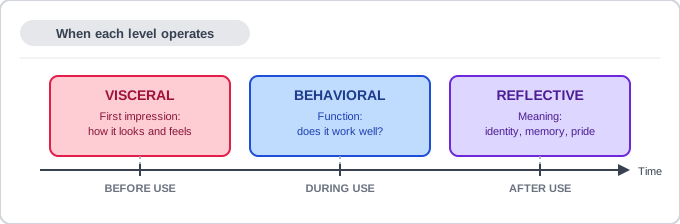 Not three checkboxes — three moments, each shaping how the others get judged.
Three levels
Visceral — immediate, unconscious first reactions driven purely by sensory qualities: color, shape, texture, sound. This is where first impressions are formed, before any actual use. Norman’s claim that “attractive things work better” operates here: an object’s look and feel create an emotional bond independent of whether it’s actually easier to use, and that bond measurably affects how forgiving people are of a product’s later usability problems.
Behavioral — concerned with function and use: what the product does, and how well it does it. Good behavioral design is human-centered, grounded in observing how people actually behave with a product in its real context of use rather than the designer’s assumptions about that context. This level maps most directly onto conventional usability work.
Reflective — the meaning a product accrues over time: the identity, memory, and self-image a person attaches to owning or using it, shaped by cultural, social, and personal associations rather than the object itself. Reflective design is why people form loyalty to brands and products beyond what their function alone would justify — it’s the level branding operates on.
Reflective design is why people form loyalty to brands and products beyond what their function alone would justify — it’s the level branding operates on.
Norman’s argument is that these three levels aren’t ranked or substitutable — a product strong on one and weak on another still fails overall, because a bad visceral impression can prevent someone from ever giving behavioral quality a chance, while good behavioral design without reflective meaning fails to build lasting attachment. A well-known example, Philippe Starck’s Juicy Salif citrus juicer, is deliberately visceral-heavy and behaviorally poor (it doesn’t juice citrus especially well) — offered as proof that a product can succeed commercially on visceral and reflective appeal even where its behavioral design is weak.
Design implications
The three levels give a vocabulary for a common design tension: a screen can be visually striking (visceral), functionally solid (behavioral), and still fail to build any lasting relationship with its users (reflective) — or vice versa. Visual Hierarchy, Color Theory, and Clear Typography are largely visceral-level tools: they shape immediate impressions before a person has done anything. Interface Design Principles‘s seven principles (consistency, feedback, error recovery, and the rest) sit at the behavioral level — they’re what make a product actually work well once someone starts using it. Reflective-level design shows up less as a checklist and more in the outcomes Trust and Credibility describes — the sense a returning customer has that a site or product is “for them,” built up over repeated encounters rather than any single screen.
The three levels give a vocabulary for a common design tension: a screen can be visually striking (visceral), functionally solid (behavioral), and still fail to build any lasting relationship with its users (reflective) — or vice versa.
Related Concepts
Patterns
Principles
Further reading
Don Norman’s Emotional Design: Why We Love (or Hate) Everyday Things (amazon.com/dp/0465051367 — commercially published, no stated open license) is the full-length book this page’s three-level framework is drawn from, developing each level with substantially more product examples and argument than the Wikipedia summary below.
Sources
Emotional Design (Wikipedia) is this page’s source — the three-level (visceral/behavioral/reflective) framework, Norman’s “attractive things work better” claim, and the Juicy Salif example of strong visceral/reflective appeal despite weak behavioral design.