
- Plan
- Explore
- Concept
- Evaluate
- Launch
Customer Research Methods
Overview
How do you validate what you think you know about customers against real data, rather than assumption?
How do you validate what you think you know about customers against real data, rather than assumption?
A family of techniques for filling in a Task Analysis and validating the elements described in Know Your Customers with real customer data. No single method is sufficient — qualitative methods (observation, interviews, focus groups) and quantitative ones (surveys) each cover different gaps, and the results feed into Card Sorting and Affinity Diagramming once enough raw data has been gathered.
Observe Customers Ethnographically
Watching customers in their normal environment (home, work) rather than only asking them about it. Its core advantage over self-report is that it captures what people actually do, not just what they say they do, and surfaces context (tools, people they interact with, artifacts they create) that’s hard to recall accurately out of context. A rigorous ethnographic study is slow; an informal “ethnographically inspired” version — following someone for a day, photographing their workspace — is much faster and still useful.
Three named variants: shadowing (researcher follows the participant through their normal activities, remaining a passive observer); guided tour (participant leads the researcher through their physical space, showing collections, tools, and artifacts — reveals context the participant embodies but cannot easily articulate when interviewed out of context); intercept interviews (conducted on-site while the user is actively mid-task, rather than before or after — captures in-the-moment behavior rather than retrospective reconstruction). All three aim at the same underlying advantage: seeing what people do, not just hearing what they say they do. Contextual Inquiry is a more structured, principle-driven version of the same underlying idea, with its own guided visit format and a dedicated interpretation session afterward.
Conduct Interviews
Best conducted in the customer’s own environment so they can show, not just describe. Practical guidance: avoid interruptions; start with easy questions before harder ones; ask open-ended questions rather than yes/no ones (avoid “Would you like this feature?” — almost everyone says yes; instead show two alternatives and ask which is better, or have people rate a list of features 1–7 on importance); be nonjudgmental; and listen more than you talk. Recording and transcribing interviews catches subtleties that note-taking alone misses.
Run interviews with at least two people on the team — an interviewer and a dedicated notetaker — and prepare a guide of key topics to cover rather than a fixed question script, so the session plays out as a guided conversation rather than a formal Q&A (having a short “elevator pitch” ready helps if a participant asks what the project is about). Two techniques sharpen what you get out of it: the 5 Whys, repeatedly asking “why” about a vague word or phrase the participant used to draw out the concrete detail behind it; and mirroring the participant’s own words back to them in question form rather than leading with your own paraphrase, which avoids cueing them toward the answer you expect. Interviewer bias is treated as unavoidable rather than something to eliminate outright — the practical fix is staying aware of it, not pretending it’s absent.
Run Surveys
Good for breadth: gathering structured (multiple-choice) and open-ended (free-form) data from many people at once, via mail, phone, in-person intercept, or the Web. Response requires incentive (a T-shirt up to cash, scaled to how long the survey takes and how senior the respondent is) and surveys longer than ~15 minutes see steep drop-off, especially online. The catch: drawing valid quantitative conclusions requires reliable data (consistent results if repeated) and statistical validity (enough responses, from a representative-enough sample) — a lot of informal Web surveys fail on one or both. Like interviews, surveys report what people say, which doesn’t always match what they do.
Run Focus Groups
6–12 representative customers discussing a site or its competitors together, useful especially early in design for gauging attitudes and reactions to sketches or scenarios. Risks: an overly controlling moderator steering toward a preferred conclusion, a dominant participant triggering groupthink in the rest of the group, and “professional respondents” who join groups for the incentive rather than because they represent real customers. Group chemistry alone can swing results from positive to very negative on the same questions, so running a focus group more than once, with different people in different locations, is safer than trusting a single session. Like surveys, focus groups reveal attitudes, not necessarily behavior.
Group chemistry alone can swing results from positive to very negative on the same questions, so running a focus group more than once, with different people in different locations, is safer than trusting a single session.
Analyze Existing Sites
Recruiting representative customers to use and critique an existing or competitor site. Starting from people who already emailed in feedback is convenient but biased — they’ve self-selected as unusually vocal or expert — so this should be supplemented with a deliberately broader sample.
Where This Leads
The unifying caveat across surveys and focus groups: both tell you what people say; if you need to know what people will actually do, you have to watch them do it.
The unifying caveat across surveys and focus groups: both tell you what people say; if you need to know what people will actually do, you have to watch them do it.
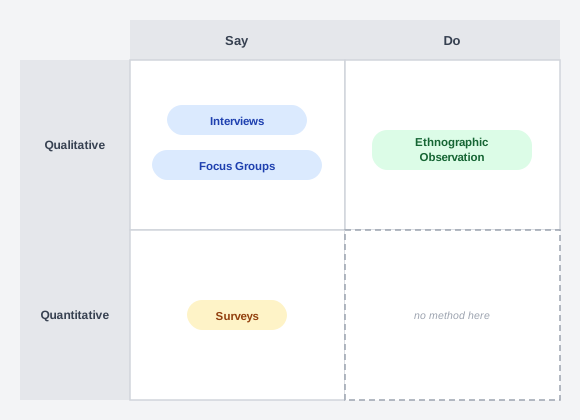 The empty quadrant is the point: nothing on this page tells you what people actually do at scale, only one at a time.
These methods are about understanding customers before a design exists; the analogous toolkit for testing customers against an actual prototype or finished design is Usability Evaluation Methods — observation and interviews here correspond to informal evaluation there, and surveys correspond to formal usability studies. The raw data these methods generate is often synthesized into a journey map — a phase-organized visualization of the user’s full experience that the whole team can read together before prototyping begins.
Related Concepts
Processes
- Know Your Customers
- Task Analysis
- Card Sorting
- Affinity Diagramming
- Usability Evaluation Methods
- Journey Mapping
- Participatory Design
- Contextual Inquiry
Further reading
Nielsen Norman Group’s “User Interviews 101” (commercially published, no stated open license) gives an independent perspective on the “Conduct Interviews” section above, on distinguishing a genuine, previously-unrecognized need from a participant’s stated opinion or feature request.
Sources
The Design of Sites: Ch. 3 — Knowing Your Customers: Principles and Techniques (Ch. 3) is this page’s primary source — the qualitative/quantitative method framework, the “Run Surveys” and “Run Focus Groups” sections (incentive scaling, response-length drop-off, reliability/validity, group-chemistry and professional-respondent risks), the “Analyze Existing Sites” section, and the recurring say-vs-do caveat.
Interviews (Digital.gov Human-Centered Design Guide) is the source for the interview-technique specifics above — running interviews with a dedicated interviewer/notetaker pair, keeping an elevator pitch ready, the 5 Whys technique, mirroring a participant’s words back as a question, and treating interviewer bias as unavoidable rather than eliminable.
Research Collaboration and HCD Guide Series (Digital.gov) (public domain, US government work) is the source for the three named ethnographic-observation variants above — shadowing, guided tour, and intercept interviews — and for the pointer to journey mapping as where the raw research data gets synthesized.