
Peak-End Rule
Overview
The peak-end rule is a psychological heuristic describing how people judge a past experience: not by its total sum or average, but almost entirely by how it felt at its peak (the single most intense moment, good or bad) and at its end. Everything else about the experience — its overall pleasantness, and critically its duration — gets remembered far more weakly, an effect known as duration neglect. This follows from a snapshot model of remembered experience: memory keeps a small number of representative snapshots rather than integrating an experience moment by moment, and the remembered value of the whole ends up close to the average of just the peak snapshot and the end snapshot.
The peak-end rule is a psychological heuristic describing how people judge a past experience: not by its total sum or average, but almost entirely by how it felt at its peak (the single most intense moment, good or bad) and at its end.
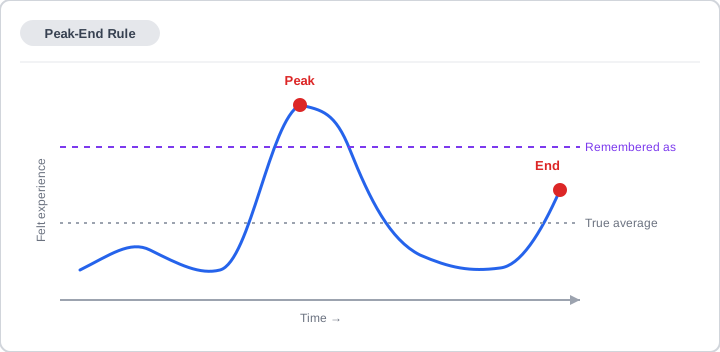 Everything between the peak and the end — including the true average — barely registers in memory.
Two causes
- Emotional-intensity bias — people retain memories of emotionally intense moments far better than mundane ones, and tend not to correct for the fact that their memory is skewed toward the extremes rather than representative of the whole.
- Recency bias — endings are simply easier to recall than earlier parts of a sequence, independent of intensity.
The rule only applies to experiences with a clear beginning and end; it doesn’t hold for open-ended or ongoing states.
Applications
- Service interactions: since most customer interactions have a defined start and end, a strong positive peak or ending (a genuinely helpful resolution, a small unprompted gesture) can outweigh friction earlier in the interaction — the mechanism behind “always end on a high note” service advice. Research on day-long or longer experiences (e.g. hotel stays) suggests the effect weakens as the experience gets longer, so it’s most reliable for short, well-bounded interactions.
- Pricing: a customer’s internal reference price behaves like a peak-end average of the highest price they’ve seen and the most recent price, which is why occasional above-normal pricing can reset a reference price upward, and why steep discounting can permanently anchor a lower one.
- Medical and other uncomfortable procedures: ending with gradually decreasing discomfort is remembered as less unpleasant than an abruptly-terminated procedure, even at equal or greater total duration.
Design implications
The rule generalizes past Kahneman’s original physical-discomfort studies to any bounded task a person completes in an interface: a multi-step process funnel or checkout flow is remembered less by its total friction than by its worst moment (a confusing step, a scary error) and its last one (the confirmation screen). A confirmation screen that is genuinely reassuring and specific — not just “Success” — has outsized influence on how the whole flow gets remembered, independent of how smooth the middle steps were. The same logic argues for closing out an error with a clear, positive-toned notification rather than leaving the interaction to end on the error itself; see Trust and Credibility for the related idea of “fail pets” softening the peak moment of an error.
The rule generalizes past Kahneman’s original physical-discomfort studies to any bounded task a person completes in an interface: a multi-step process funnel or checkout flow is remembered less by its total friction than by its worst moment (a confusing step, a scary error) and its last one (the confirmation screen).
Related Concepts
Patterns
Principles
Further reading
Kahneman, Fredrickson, Schreiber, and Redelmeier’s “When More Pain Is Preferred to Less: Adding a Better End” (Psychological Science, 4(6), 401–405, 1993 — commercially published, no stated open license) is the original cold-water experiment behind the peak-end rule: subjects preferred repeating a longer, more painful trial over a shorter one, purely because the longer trial’s water was gradually warmed at the end — direct evidence that duration barely factors into retrospective evaluation compared to the peak and the ending.
Sources
Peak-End Rule (Wikipedia) (CC BY-SA) is this page’s source — the snapshot model and duration-neglect effect, the emotional-intensity-bias and recency-bias explanation for the two causes, the boundary condition limiting the rule to experiences with a clear beginning and end, and the service/pricing/medical application examples.