
Cognitive Load
Overview
Cognitive load is the total mental effort being used by working memory at any given moment. Because working memory has a hard capacity limit, interface decisions that add unnecessary load — surplus choices, unfamiliar patterns, visual clutter, inconsistent layouts — directly consume capacity that the user needs to perform the task the interface is supposed to support.
Cognitive load is the total mental effort being used by working memory at any given moment.
Because load itself isn’t directly observable, it has to be measured rather than assumed. NASA-TLX is the field’s standard instrument for measuring cognitive load — a six-subscale subjective workload questionnaire, typically added to a formal usability study alongside behavioral metrics, that puts an actual number on how much effort a task actually cost.
NASA-TLX is the field’s standard instrument for measuring cognitive load — a six-subscale subjective workload questionnaire, typically added to a formal usability study alongside behavioral metrics, that puts an actual number on how much effort a task actually cost.
Working memory limits
Working memory holds only a small number of items simultaneously — commonly cited as 7±2 “chunks,” though estimates run as low as 4±1 items when chunking strategies aren’t available, that is, when items can’t be compressed into meaningful groups by the observer. The practical implication for design is that an interface presenting more than four to seven independent items simultaneously — choices, labels, competing calls to action, navigation options — is contending with working memory rather than supporting it. Each additional item beyond the limit does not just slow users down; it causes the earlier items to be dropped entirely.
Each additional item beyond the limit does not just slow users down; it causes the earlier items to be dropped entirely.
Three types
Cognitive load theory distinguishes three kinds:
Intrinsic load — the inherent complexity of the task itself, independent of how it is presented. Filing a tax return is intrinsically complex; toggling a setting is not. Interface design cannot eliminate intrinsic load, but it can avoid compounding it with unnecessary interface complexity.
Extraneous load — complexity introduced by the presentation or interface beyond what the task requires. A form that asks for information in a counterintuitive sequence, navigation labels that don’t match user vocabulary, an error message that describes the failure without explaining recovery — all impose load that has nothing to do with the underlying task. Extraneous load is the primary target of good UX: minimize it.
Extraneous load is the primary target of good UX: minimize it.
Germane load — mental effort spent building understanding or mental models. Learning how a site’s navigation works on the first visit is germane load: it is not task-relevant in the moment, but it enables faster subsequent use. Consistent patterns reduce germane load across visits: once a pattern is learned, applying it costs nothing. This is the underlying mechanism behind Interface Design Principles‘s consistency principle (principle 1) — consistency amortizes the germane load of learning over many uses — and recognition over recall (principle 3), which offloads working memory onto the visible interface.
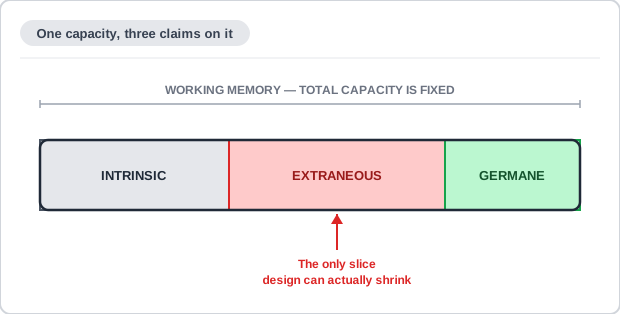 All three draw on the same fixed budget — only the middle one is design’s to reduce.
Design implications
Reducing extraneous load does not mean making interfaces simpler at the cost of functionality — it means making the interface’s complexity independent from the task’s inherent complexity. A feature-rich tool with consistent organization and learnable patterns can have lower extraneous load than a sparse interface with opaque labels and unpredictable behavior.
Practical reductions:
- No more than five to seven choices visible at a navigation decision point: per Hick's Law, decision time grows logarithmically with the number of options, so fewer simultaneous choices means lower extraneous load at that decision point — even when the total option count doesn’t change, since an organized set of options can be traversed with a binary-search-like process rather than a linear scan, and that logarithmic benefit degrades once the options aren’t well-organized
- Error messages explain recovery, not only failure — an unrecovered error leaves uncertainty in working memory until the user resolves it
- Labels use the user’s vocabulary, not the system’s — vocabulary mismatch forces translation, which occupies working memory
- Avoid stacking two strong, conflicting cues in working memory at once — a highlighted Cancel button beside a plain Save button, or a code that could be misread as a price — since resolving the conflict correctly costs more than a single unambiguous cue would; see Stroop Effect for the underlying interference
- Consistent layout across pages — familiar structure is processed automatically, freeing capacity for content
- Visual grouping reflects logical grouping: per Gestalt Psychology‘s proximity, similarity, and closure principles, elements that are visually grouped can be held as a single chunk rather than individual competing items, expanding the effective working-memory capacity for a page — a layout that groups by visual affinity rather than logical relationship instead imposes a translation step at every read
- Meter information with Progressive Disclosure so only what’s needed for the current step is visible — this directly manages extraneous load by reducing the number of items competing for working memory at once, while keeping the total content available, just deferred until it’s relevant
- Communicate what the interface can do and what just happened, closing the gulfs of execution and evaluation — leaving either open forces the user to hold uncertainty in working memory instead of forming their next intention freely; a change that’s technically communicated but too subtle to notice (Change Blindness) has the same cost as no communication at all, since the user still has to actively search the page to resolve the uncertainty
- Keep clickable targets large enough per Fitts's Law — a target that demands close attention to hit splits cognitive resources between the task at hand and the physical act of pointing
- Limit how many floating controls compete for attention at once in a spatial interface — each one occupies working memory the same way an on-screen toolbar button would, so a scene crowded with auxiliary controls imposes the same extraneous load a cluttered flat UI does
- Show rather than describe, when both are options: a visual (an image, a live preview, a diagram) conveys inherently visual or spatial information directly, while a verbal description of the same thing forces the reader to reconstruct it mentally first — extraneous load with no benefit to the underlying task
- Treat interruption as a load cost, not a free action: frequent notifications and context-switching prompts measurably raise cognitive load and degrade task performance, so an interface competing for attention mid-task is spending a customer’s limited working-memory budget on itself rather than their goal
Whether a change actually reduced load, rather than merely seeming like it should, is what NASA-TLX measures directly (see Overview above) — added to a formal usability study alongside behavioral metrics rather than left as an inference from the design.
Related Concepts
Patterns
Principles
- Hick's Law
- Gestalt Psychology
- Gulfs of Execution and Evaluation
- Change Blindness
- Stroop Effect
- Fitts's Law
- Interface Design Principles
- Mental Models
- Recognition Over Recall
- Motion Design
Processes
Further reading
Nielsen Norman Group’s “Minimize Cognitive Load to Maximize Usability” (commercially published, no stated open license) names a reduction this page’s own list doesn’t call out directly: cutting decorative visual clutter — redundant links, irrelevant images, ornamental typography — since it draws on the same working-memory budget as content actually relevant to the task.
Sources
Cognitive Load (Wikipedia) (CC BY-SA 4.0) backs the three-load-type framework (intrinsic/extraneous/germane) and the working-memory capacity figure cited above, and is the source for the show-rather-than-describe and interruption-cost points in Design implications.