
Recognition Over Recall
Overview
The usability principle that visible, selectable options are easier to use than information a customer has to remember unaided (see Interface Design Principles principle 3, and Nielsen’s sixth usability heuristic) has a real cognitive-science mechanism behind it: recognition and recall are distinct memory processes, and recognition is reliably easier.
recognition and recall are distinct memory processes, and recognition is reliably easier.
Two different memory processes, not one ability
Recognition memory matches something encountered again against a stored memory representation — a customer sees an option and judges whether it’s familiar. Recall requires retrieving a specific memory trace with nothing present to match it against — a customer has to reconstruct the information from scratch. Recall is a two-stage process (search, then a decision/recognition step to confirm what was retrieved is correct); recognition only needs the second stage, which is why it fails less often.
Recall is a two-stage process (search, then a decision/recognition step to confirm what was retrieved is correct); recognition only needs the second stage, which is why it fails less often.
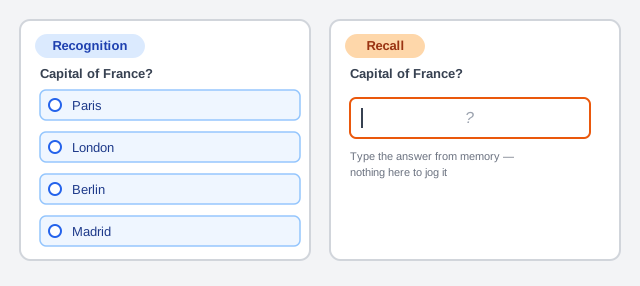 Visible options only need recognition — a blank field forces recall instead.
Recollection vs. familiarity
Recognition itself splits into two processes: recollection, a slow, controlled retrieval of specific details (associated with the hippocampus), and familiarity, a fast, automatic sense that something has been seen before, with no specific details attached (associated with the surrounding medial-temporal regions, particularly the perirhinal cortex). The classic illustration is the “butcher-on-the-bus” phenomenon: seeing someone whose face is unmistakably familiar without being able to place who they are or where you know them from — familiarity firing well ahead of recollection. A customer can recognize an interface element as something they’ve seen before while having no idea what it does.
Limitations
Recognition isn’t infallible: research on recognition-based testing warns that a good test shouldn’t rely on recognition alone, since a customer can recognize an option as familiar without that familiarity meaning it’s the correct one — multiple-choice-style recognition can produce false confidence.
What recall does better
Recall isn’t always worse — the encoding-specificity principle (retrieval works best when the context at retrieval matches the context at encoding) and the testing effect (actively retrieving information strengthens memory of it more than re-reading does) both describe real recall advantages, and free/cued/serial recall each have their own primacy and recency patterns (items at the start and end of a list are remembered better than the middle). Recall’s difficulty is a tradeoff to design around, not evidence that recall has no place.
Design implications
- Favor visible, selectable options over a blank field the customer has to fill from memory — this is the direct payoff of recognition’s easier, single-stage process over recall’s two-stage one.
- Keep labels visible even next to a recognizable icon. A customer can recognize an icon as familiar without recalling what it does, so recognition alone doesn’t guarantee comprehension (see Icons).
- Don’t rely on “looks familiar” as the only signal in a decision that needs to be correct, not just remembered — a choice that requires genuinely correct input needs its own verification step beyond recognition-based confidence.
- Use recall deliberately where recognition would defeat the task’s own purpose. A password or PIN needs recall’s harder retrieval precisely because a recognizable, guessable option would be a security failure rather than a convenience; a task meant to strengthen memory benefits from the testing effect’s active retrieval rather than a recognition-based shortcut.
Use recall deliberately where recognition would defeat the task’s own purpose.
Related Concepts
Patterns
Principles
Processes
Further reading
Nielsen Norman Group’s “Memory Recognition and Recall in User Interfaces” (commercially published, no stated open license) applies this page’s cognitive-science distinction directly to interface design — search history, saved favorites, and labeled icons as recognition-friendly examples, set against command-line syntax and gesture-only tutorials as recall-dependent failure cases — and frames memory activation as depending on practice frequency, recency, and context, not ability alone.
Sources
Recognition Memory (Wikipedia) is the source for the Recollection vs. familiarity section — the hippocampus/perirhinal-cortex distinction, the “butcher-on-the-bus” phenomenon, and the caution against relying on recognition alone in a test, covered under Recognition’s limits.
Recall (Memory) (Wikipedia) is the source for the What recall does better section — the encoding-specificity principle, the testing effect, and the primacy/recency patterns in free/cued/serial recall — plus the two-stage search-then-recognition account of recall described in Two different memory processes.