
Grassroots Information Sites
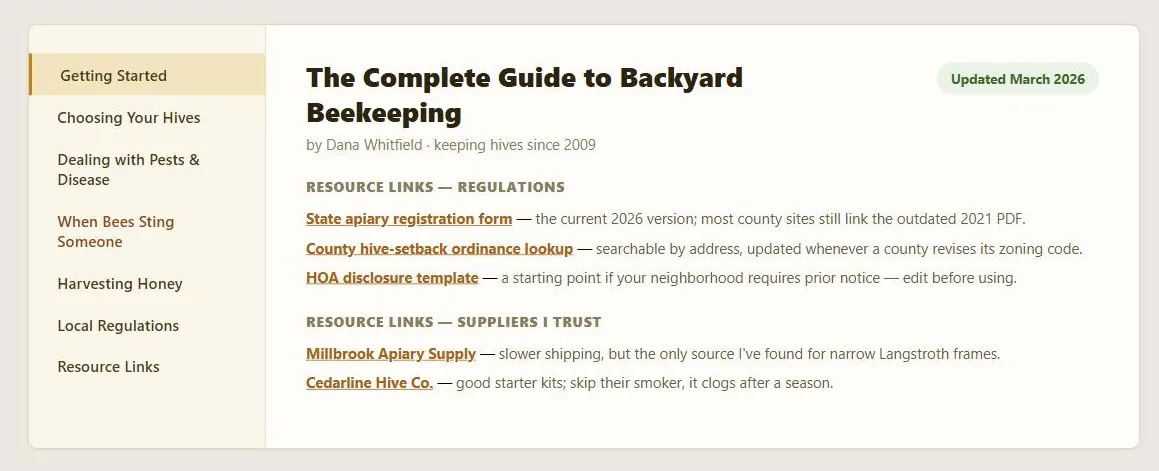 The visible update date and the “When Bees Sting Someone” topic are the credibility signals; the annotation on every link — not just a bare URL — is the curation this pattern is actually built on.
Background
A grassroots information site exists because official and corporate sources rarely go as deep on a niche topic as a genuinely passionate individual will — the site’s whole appeal comes from being run by an enthusiast rather than an institution. A grassroots site that succeeds often reaches a point where static content isn’t enough — the natural next step is opening it up for reader participation, which turns it into a community conference as well as an information resource.
A grassroots information site exists because official and corporate sources rarely go as deep on a niche topic as a genuinely passionate individual will — the site’s whole appeal comes from being run by an enthusiast rather than an institution.
Problem
Search engines return reams of individually-ranked results, but even a highly-ranked individual page usually offers only one fragment of a topic, not an organized overview — so people acting on the first few search results alone often act on partial information.
Search engines return reams of individually-ranked results, but even a highly-ranked individual page usually offers only one fragment of a topic, not an organized overview — so people acting on the first few search results alone often act on partial information.
Solution
A grassroots information site is built by someone with deep personal interest in a topic who has already done the work of scouring the Web for the best available information, then makes that comprehensive picture available to others.
Establish credibility
Because a grassroots site’s whole value proposition is trustworthy comprehensiveness, credibility has to be earned deliberately: date every page so readers can judge how current the information is, and answer the tough questions rather than only the easy ones — readers specifically respect sites that don’t dodge difficult territory. See Trust and Credibility for the general case this is a specific instance of.
Write for two audiences at once
A grassroots site’s writing has to work for search engines (see Search Engine Optimization) and for human readers simultaneously. For fact-based, authority-seeking sites, an inverted-pyramid structure (see Plain Language) serves both — but the source is explicit that this style is wrong for sites with a sarcastic or storytelling voice, where the whole appeal is the personality of the writing, not front-loaded conclusions.
Curate external links well
A long, uncommented list of External Links gives a reader no way to tell which links are worth their time — the value a grassroots curator adds over a raw search result list is precisely the editorializing: a line or two per link describing what it covers and what the curator thought of it. Once a link list grows large, group it under high-level category labels using a hierarchical organization rather than one long undifferentiated list; the source’s specific numeric guidance is to keep any single list to roughly 15–20 links, cap top-level categories at under 20, and break anything larger into subcategories — a range even established high-traffic directories like Yahoo! Directory and Google Directory didn’t exceed at any level, however large the directory grew overall.
the source’s specific numeric guidance is to keep any single list to roughly 15–20 links, cap top-level categories at under 20, and break anything larger into subcategories
Related Concepts
Patterns
- External Links
- Content Organization Schemes
- Search Engine Optimization
- Plain Language
- Community Conference
- Blogs
Principles
Sources
The Design of Sites: Pattern Group A — Site Genres is this page’s source — its A6 Grassroots Information Sites pattern supplies the credibility-through-dating-and-comprehensiveness guidance, the dual-audience writing advice, and the 15–20-link/20-category curation thresholds above.