
Featured Products
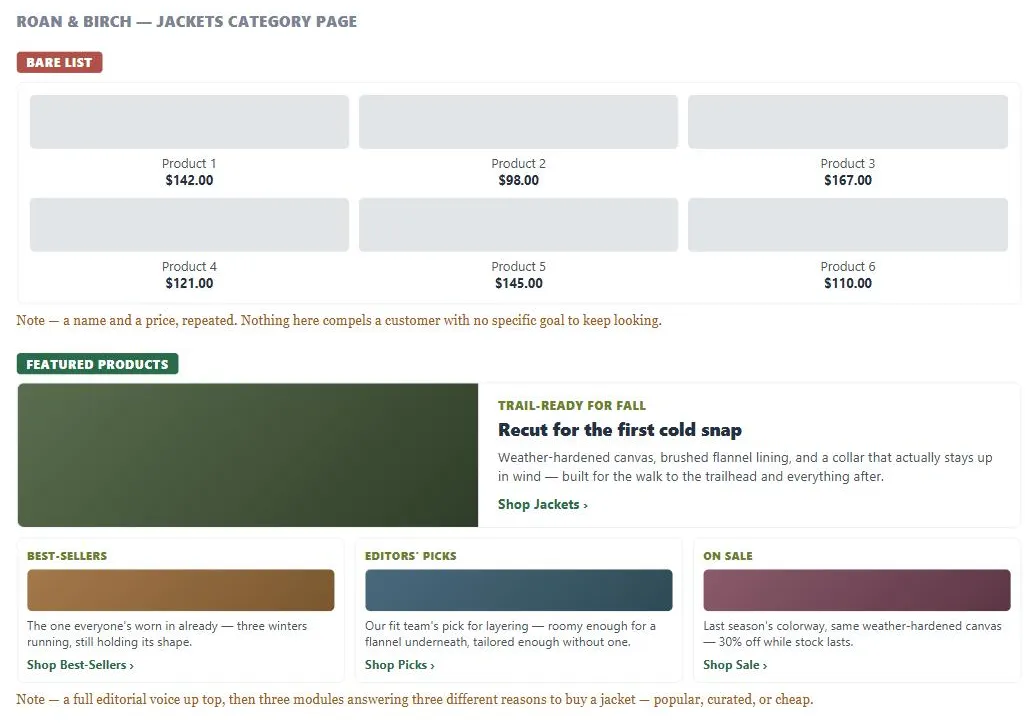 Same six jackets, two different invitations to keep browsing — one gives a customer with no specific goal nothing to go on, the other gives them three different reasons to click.
Background
A featured-products list must be easy to update (manually or automatically) or it goes stale fast, which undercuts the “always something new” promise that justifies it in the first place.
A featured-products list must be easy to update (manually or automatically) or it goes stale fast, which undercuts the “always something new” promise that justifies it in the first place.
Problem
A site with tens, hundreds, or millions of products looks bland and tedious if the only ways in are long lists or a search box — customers who like to browse, rather than search for something specific, find nothing to explore.
A site with tens, hundreds, or millions of products looks bland and tedious if the only ways in are long lists or a search box — customers who like to browse, rather than search for something specific, find nothing to explore.
Solution
Build category-level pages that highlight a curated subset of products, editorialized rather than presented as a bare name/picture/price list:
Editorialize
A short description with personality (friendly, authoritative, wisecracking — whatever voice the site picks, applied consistently) substitutes for the salesperson a customer would get in a physical store, and makes the recommendation feel less like an algorithm.
A short description with personality (friendly, authoritative, wisecracking — whatever voice the site picks, applied consistently) substitutes for the salesperson a customer would get in a physical store, and makes the recommendation feel less like an algorithm.
Offer different kinds of recommendations for different shopper motivations
“Best-Sellers,” “Editors’ Picks,” “Rare Finds,” “New Releases,” “On Sale” — since one customer wants what’s popular while another wants what’s cheap or what’s new. Cross-reference what a recommendation is for (a product type, a brand, a price point, a gift) against category pages, Search Action Module, Gift Giving, and process-funnel-driven gift finders to decide which tool fits which need.
Provide opportunities to explore
For visitors with no specific goal in mind — highlighting imagery and detail (rather than a dense list) compels browsing-minded customers to click through. This is the principle of exemplars applied to a whole category page: a few real, curated products describe what’s inside better than the category’s name alone.
Related Concepts
Patterns
- Cross-Selling and Up-Selling
- Personalized Recommendations
- Recommendation Community
- Category Pages
- Search Action Module
- Organized Search Results
- Gift Giving
- Process Funnel
- Clean Product Details
- Shopping Cart
Principles
Processes
Sources
The Design of Sites: Pattern Group G — Advanced E-Commerce is this page’s G1 Featured Products pattern source — editorializing curated lists (Best-Sellers, Editors’ Picks, On Sale) for browsing-minded customers with no specific product in mind.