
Personalized Recommendations
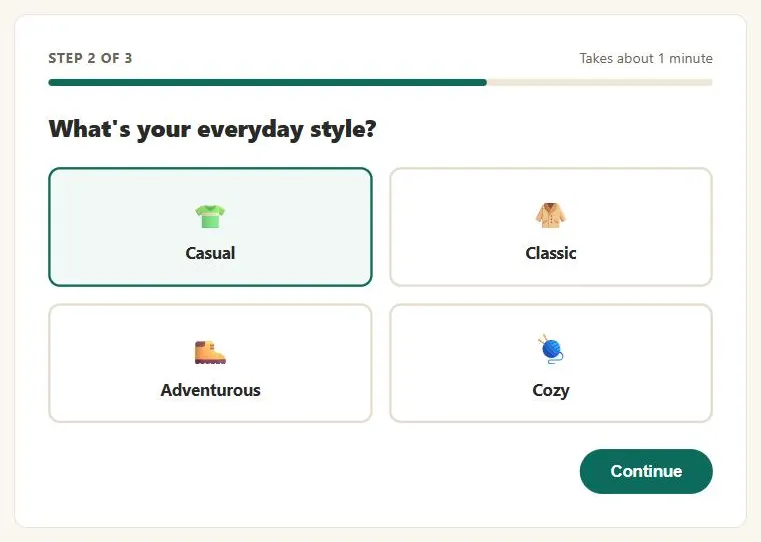 A short, time-boxed interview like this trades a little customer effort for a signal far more reliable than anything inferred from browsing alone.
Background
Personalized recommendations are the e-commerce-specific instance of the general Personalized Content pattern (targeting content modules to a visitor rather than product suggestions specifically) — the same intentional-vs-automatic targeting distinction, and the same caution against front-loading the personalization ask, apply to both. The more deliberate and specific the data a recommendation is based on (an explicit rating, an interview answer), the more reliable it is — but also the more effort it asks of the customer, so each technique trades signal quality against participation.
Problem
Personalized recommendations make shopping easier when they’re good, but generating them well requires real customer data — and the easiest data to collect (where someone clicked, what they searched for) is also the least reliable.
Personalized recommendations make shopping easier when they’re good, but generating them well requires real customer data — and the easiest data to collect (where someone clicked, what they searched for) is also the least reliable.
Solution
Prefer recommendations grounded in deliberate customer behavior over data inferred from incidental browsing:
Avoid purely inferred data
A page visit alone doesn’t mean a customer wanted what’s on that page — they might have clicked the wrong link or mistyped a search term. Recommendations built only on referrer logs or path data can ring hollow because the underlying signal is noisy.
Make rating easy and immediate
Letting customers rate products they’ve bought (or are just familiar with) gives a much more reliable signal than inference, but only if the friction is low — e.g. a rating control that updates the page instantly rather than requiring a form submission and reload.
Offer a short preference interview as an alternative to ratings
Especially for complex or unfamiliar product categories — a brief process funnel that ends in tailored suggestions. Keep it short and tell customers up front how long it’ll take, since a long interview with unclear payoff invites abandonment.
Explain why a recommendation was made
In plain terms (“customers who liked X also liked these”) rather than describing the algorithm — customers who don’t understand or trust a recommendation’s basis tend to ignore it.
In plain terms (“customers who liked X also liked these”) rather than describing the algorithm — customers who don’t understand or trust a recommendation’s basis tend to ignore it.
Show several recommendations at once, including ones the customer already likes
This lets customers sanity-check the system themselves: if it’s surfacing things they already know they like, they’re more likely to trust the new suggestions mixed in alongside them.
Address privacy directly
Personalization runs on the same customer data that Trust and Credibility says has to be handled visibly and honestly — disclose what’s collected and how it’s used, and use explicit opt-in for anything beyond the recommendation itself (e.g. using the data for outside marketing). See Privacy Preferences for how that choice should actually surface in the interface.
Personalization runs on the same customer data that Trust and Credibility says has to be handled visibly and honestly — disclose what’s collected and how it’s used, and use explicit opt-in for anything beyond the recommendation itself (e.g. using the data for outside marketing).
Related Concepts
Patterns
- Featured Products
- Cross-Selling and Up-Selling
- Recommendation Community
- Process Funnel
- Privacy Preferences
- Customer Sessions
- Personalized Content
- Content Modules
Principles
Processes
Sources
The Design of Sites: Pattern Group G — Advanced E-Commerce is this page’s source — Pattern G3, covering the caution against purely inferred data, easy/immediate rating controls, the short preference-interview alternative, explaining a recommendation’s basis in plain terms, and the privacy-disclosure requirement for using the underlying data beyond the recommendation itself.