
Personalized Content
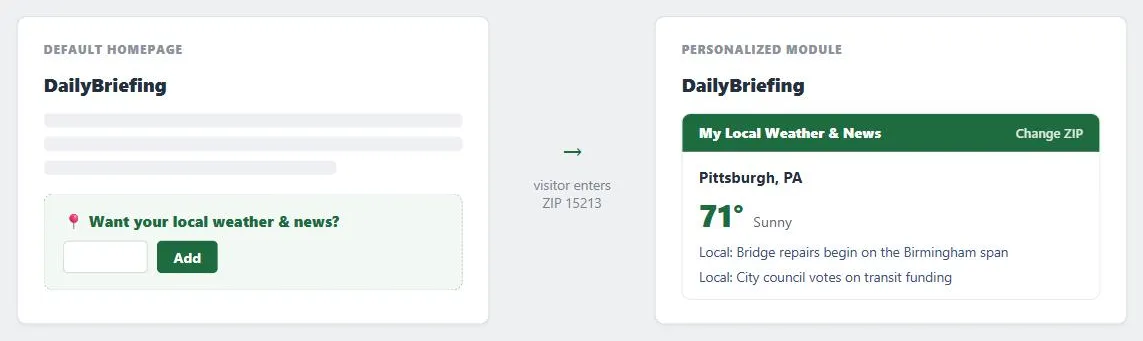 The invitation sits beside a normal homepage, not instead of one — visitors get the generic default either way, and the personalized module only appears once they’ve chosen to answer a single question.
Background
Personalized content targets what a page template‘s content modules display to the specific visitor rather than showing every visitor the same thing. Personalized recommendations are the e-commerce-specific instance of this same general pattern, applied to product suggestions rather than to content modules.
Problem
Personalized content, done badly — engineered before the site’s basic structure is in place, or forced on visitors before they’re ready — produces worse results than showing everyone the same generic content. Mismatched targeting compounds the risk: automatic personalization can misread intent, and intentional personalization only works if visitors are willing to spend the effort it asks for.
Personalized content, done badly — engineered before the site’s basic structure is in place, or forced on visitors before they’re ready — produces worse results than showing everyone the same generic content.
Solution
Done well, personalized content gives customers a reason to keep returning — layered on top of a solid default experience rather than forced upfront.
Target content two ways: intentionally or automatically
Intentional personalization uses information a customer explicitly provides. Automatic personalization infers interests from what a visitor does — pages visited, links clicked, items bought — without asking. The two can be combined, and each has a distinct failure mode: automatic personalization can mis-infer intent when a visitor’s actions don’t match their goal (someone who lands on a cooking-class page while looking for recipes gets profiled as interested in classes), while intentional personalization only works if visitors are willing to spend the effort answering questions.
Don’t front-load the ask
Visitors don’t know they want personalization until they’ve spent time on a site — requiring information up front before they’ve seen any value drives them away. Show new visitors a reasonable default experience first (e.g. featured products, to demonstrate what other customers already find valuable), then make an explicit, enticing invitation to personalize once they understand what they’d get from it. How much to reveal up front varies by site, as the example above shows.
Visitors don’t know they want personalization until they’ve spent time on a site — requiring information up front before they’ve seen any value drives them away.
Gather the signal
Four techniques, the first two intentional and the last two automatic:
- Edit — visitors directly choose and arrange which content modules appear, optionally via Direct Manipulation.
- Interview — visitors answer a short multiple-choice questionnaire; responses are stored in a profile for later reuse.
- Deduce — the system observes behavior (e.g. past purchases) and infers preferences from it.
- Filter (collaborative filtering) — content favored by customers with a similar profile is surfaced to a given visitor, without that visitor supplying any information directly.
A visual-design instance of the Deduce technique: Google‘s Material You (Material Design 3, 2021) generates a device’s entire UI color theme algorithmically from the user’s own wallpaper — automatic personalization applied to visual styling itself, rather than to which content modules or products a customer sees. See Material Design (Wikipedia).
Background information customers are willing to share (location, age, stated interests) is often more useful than behavior alone — a ZIP code alone can drive relevant local weather, news, and traffic content. Location-Based Services push this further, targeting content by a customer’s continuously-updated real-time location rather than a one-time-entered ZIP code.
Map people to content
Categorize content the same way Browsable Content already organizes it for browsing, so the personalization scheme stays consistent with the rest of the site’s information architecture. Content and customers can then be matched with a simple map (a customer profile tagged “art” sees content tagged “art”) or with a more elaborate scheme, scoring both customers and content along shared dimensions (e.g. skill-level vectors) and matching by proximity. Automatic scoring can use several methods interchangeably: ranking all customers on a metric, taking only the top scorers, applying a threshold, or filtering by a required attribute.
Persist profiles, but honor privacy obligations
Cookies are the usual mechanism for remembering a returning visitor’s profile without requiring sign-in on every visit — see Customer Sessions. Because cookies are device-specific, offer account management so a signed-in customer’s personalization follows them across machines, and so a recovery path exists if a cookie is lost. Collecting profile data — especially anything covered by data-protection law or rules about minors — brings the site’s fair information practices, Privacy Policy, and Privacy Preferences into scope; disclose what’s collected and why.
Collecting profile data — especially anything covered by data-protection law or rules about minors — brings the site’s fair information practices, Privacy Policy, and Privacy Preferences into scope; disclose what’s collected and why.
Related Concepts
Patterns
- Content Modules
- Page Template
- Personalized Recommendations
- Browsable Content
- Account Management
- Customer Sessions
- Direct Manipulation
- Privacy Policy
- Privacy Preferences
- Location-Based Services
Standards
Sources
The Design of Sites: Pattern Group D — Writing and Managing Content is this page’s source — Pattern D4’s intentional-vs-automatic personalization distinction, the caution against front-loading the personalization ask, the four gather-the-signal techniques (edit, interview, deduce, filter), and the account/cookie/privacy obligations personalization brings with it.
Material Design (Wikipedia) (CC BY-SA) supplies the Material You (Material Design 3, 2021) example of wallpaper-derived color-theme personalization, cited here as a visual-styling instance of the Deduce technique.